
Most founders don’t fail because they hired the wrong developer. They fail because they hired the wrong developer for the wrong reasons, no brief, no acceptance criteria, no understanding of what “done” actually means. The result is a blown budget, a missed launch window, and an app that either crashes on first open or gets rejected from the App Store entirely.
This guide is different. It’s a product-first hiring playbook built from the studio side of the table, the side that sees hundreds of briefs, evaluates dozens of developers, and ships MVPs on fixed timelines. You’ll walk away with concrete artifacts: a job brief template, a scored take-home task with a rubric, contract clauses that protect your IP and runway, and a decision matrix that maps your actual product goals to the right hiring model and tech stack. Whether you end up hiring a freelancer, an agency, or building an in-house team, every section here is designed to help you make the decision that ships.
Why Most Hiring Guides Fail You
Go search “hire mobile app developer” right now. You’ll find listicles that tell you to “check their portfolio” and “look for good communication skills.” That’s not a hiring strategy. That’s a platitude dressed up as advice.
The real constraints founders face aren’t generic. They’re specific and painful: you have $15,000-$30,000 of runway allocated to your MVP. You need to launch before a competitor closes their seed round. Your app needs to pass App Store review on the first submission, because a two-week rejection cycle means missing your demo day. And after launch, you need someone who actually picks up the phone when your Firebase authentication flow breaks at 2 AM on a Saturday.
A bad mobile hire doesn’t just waste money. It costs you runway, delays investor conversations, and can produce an app that looks finished in a demo but crashes under real user load. The difference between a good hire and a great one often comes down to whether they’ve actually shipped to production, handled App Store rejections, debugged memory leaks on low-end Android devices, and implemented CI/CD for mobile so that hotfixes go out in hours, not days.
This guide covers three hiring models, freelancer, agency or studio, and in-house, and maps each to specific product goals. The right answer depends on where you are in your product lifecycle, not just what you can afford.
Pick the Right Hiring Model First
Before you write a job post or message a single developer on LinkedIn, you need to answer one question: what does your product need right now? Not in six months. Not when you’ve raised your Series A. Right now. The answer determines which hiring model actually serves you, and which ones will quietly bleed your timeline dry.
Freelancer, Agency, or In-House
Freelancers offer cost flexibility and speed to start. You can find a strong Flutter developer or React Native specialist on Toptal within a week and have them writing code by the following Monday. The tradeoff: there’s no backup. If your freelancer gets sick, takes another contract, or simply ghosts (it happens more than anyone admits), your project stops. There’s no second engineer to pick up the codebase. Coordination risk is entirely on you, you’re the project manager, the QA lead, and the product owner rolled into one.
Agencies and studios offer accountability and full-stack delivery. A studio like CompletApp, for example, runs fixed-price MVP builds in 4-week sprints with milestone-based payments, meaning you know the cost before you start and you get a working product at the end, not a half-finished prototype. The tradeoff is higher fixed cost and less flexibility to pivot mid-sprint without renegotiating scope. But you get a team: a developer, a designer, someone handling app store submission, and a project lead who keeps the timeline honest.
In-house hires give you long-term control and deep product context. But here’s the math most founders ignore: a senior mobile developer takes 3-6 months to recruit, onboard, and ramp to full productivity. If you’re pre-revenue and need an MVP in 8 weeks, an in-house hire is the wrong tool. In-house makes sense post-product-market fit, when iteration speed requires a dedicated engineer embedded in daily standups, reviewing mobile analytics in Amplitude or Firebase Analytics, and shipping weekly builds through your CI/CD pipeline.
The Decision Matrix
Map your product goals to the model that actually fits:
| Product Goal | Best Model | Why |
|---|---|---|
| MVP in under 8 weeks, fixed budget | Studio (fixed-price) | Predictable cost, built-in accountability, handles app store submission |
| Single feature or integration add-on | Freelancer | Scoped work, short engagement, cost-efficient |
| Post-PMF, weekly iteration cycles | In-house hire | Deep product context, daily availability, long-term ownership |
| Cross-platform launch (iOS + Android) | Studio or single Flutter developer | One codebase ships both platforms; avoids hiring separate native iOS Swift and Kotlin Android developers |
| Complex AI integration (OpenAI, Claude) | Studio with AI experience | Requires prompt engineering, API cost control, safety mitigations, hard to vet in a solo freelancer |
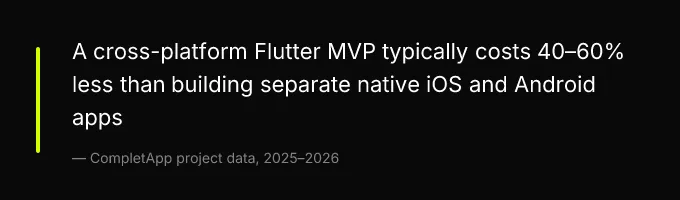
The cross-platform decision deserves special attention here. In 2026, a single Flutter developer or studio can ship iOS and Android simultaneously from one codebase. That changes the cost math dramatically: instead of hiring a Swift developer and a Kotlin developer (two salaries, two codebases, two sets of bugs), you hire one person or team and get both platforms. For most startups building an MVP with standard features, authentication via Firebase or Supabase backend, a user onboarding funnel, payment integration, cross-platform mobile development is the default-correct choice.
Write a Brief That Attracts the Right Developer

Vague briefs attract vague developers. Specific briefs, the kind that describe the problem, the constraints, and what “done” looks like, attract developers who actually ship.
The quality of developers who respond to your post is directly proportional to the quality of your brief. Vague briefs attract vague developers. Specific briefs, the kind that describe the problem, the constraints, and what “done” looks like, attract developers who actually ship.
What a Strong Job Post Includes
Most job posts fail because they describe the company for three paragraphs and then say “we need a mobile app.” That tells a developer nothing about the actual work. A strong brief leads with the information a competent developer needs to decide whether they’re the right fit:
- Platform targets: iOS only, Android only, or cross-platform (Flutter, React Native)
- Core feature set: List the 3-5 features that define your MVP. Not a 40-item backlog, the features that must work on day one.
- Tech stack preferences or requirements: If you already have a Supabase backend or need Firebase authentication, say so. If you’re open, say that too.
- Timeline: “We need a working TestFlight build in 6 weeks” is useful. “ASAP” is not.
- Acceptance criteria for milestone one: Define what “done” looks like for the first deliverable. Example: “User can sign up via email, complete the onboarding flow (3 screens), and land on a populated home screen pulling data from the API. Cold start under 2 seconds on iPhone 12 or equivalent Android.”
- Budget range: Founders who hide the budget waste everyone’s time. A developer who charges $120/hr needs to know if your budget is $10,000 or $50,000 before they invest time in scoping.
This isn’t just about attracting better candidates. It’s about filtering out the ones who can’t deliver. A developer who reads a brief with clear acceptance criteria and responds with “yeah I can do that, when do I start?”, without asking a single clarifying question, is telling you exactly how they’ll handle ambiguity during the build.
Portfolio and App Store Evidence to Require
Require live App Store or Google Play links. Not mockups. Not Figma prototypes. Not screenshots of apps that may or may not exist. You want to see apps that survived review, that have real ratings, and, if accessible, a crash-free rate above 99%. Ask for at least one app with 1,000+ downloads that the candidate built end-to-end, not just “contributed to.”
Look for evidence of third-party integrations: Stripe or RevenueCat for payments, Firebase or Supabase for backend services, and, increasingly in 2026, AI integration with OpenAI or Claude APIs. If your product includes any AI-powered features, you need a developer who can describe their prompt engineering decisions, explain how they handle API cost control (token limits, response caching, fallback behavior when the API is down), and detail what safety mitigations they’ve implemented for user-facing LLM features. This is a growing gap: many developers can call an API, but few have thought through what happens when the model hallucinates in a health or finance context.
Red flags to watch for: apps that only exist as screenshots or Behance case studies, vague answers about app store submission experience (“my client handled that”), no mention of rejection handling, and an inability to explain mobile performance profiling decisions. If a candidate can’t tell you what Xcode Instruments or Android Studio Profiler is, they haven’t shipped a production app that needed to perform under real conditions.
Evaluate Candidates Without Wasting Time
Interviews are theater. A developer can talk about clean architecture for an hour and still deliver spaghetti code. The only reliable signal is work product, but you need to structure the evaluation so it’s fair, efficient, and actually predictive of how they’ll perform on your project.
The Take-Home Task and Scoring Rubric
Here’s the framework that works: a 2-week timebox, a single MVP-scoped feature, explicit acceptance criteria, and payment at a day rate. Pay the candidate. Serious developers won’t spend 15+ hours on an unpaid task, and the ones who will are often the ones with no other options, which tells you something.
Example task: Build a subscription paywall screen using RevenueCat with a working sandbox purchase flow. The screen should display two plan options, handle a successful purchase, handle a failed transaction, and support restore purchases. Deliver as a working Flutter project with a README that includes setup instructions and a 60-second Loom walkthrough.
Score across four dimensions, each weighted equally at 25 points:
| Dimension | What You’re Evaluating | Score Threshold |
|---|---|---|
| Code quality & architecture | Follows platform conventions, separation of concerns, no business logic in UI layer | 18+ out of 25 to pass |
| UI fidelity | Matches the spec without being asked twice, handles loading and error states | 18+ out of 25 to pass |
| Integration correctness | Payment flow handles edge cases (restore, failure, network timeout) | 20+ out of 25 to pass |
| Communication | Asked clarifying questions upfront, provided progress updates, delivered on time | 15+ out of 25 to pass |
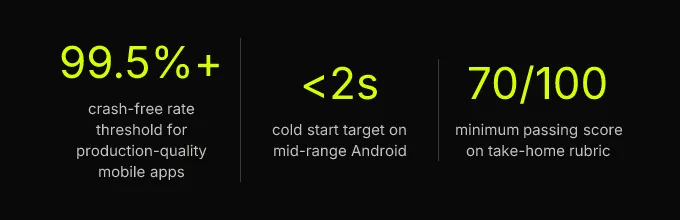
A candidate who scores below 70 out of 100 is a no. A candidate who scores 85+ and asked smart questions before starting is almost certainly going to deliver well on your actual project.
One additional request that separates serious candidates: ask them to share mobile performance profiling output. Specifically, Xcode Instruments or Android Studio Profiler screenshots showing memory usage, CPU during scroll, and cold startup time. A Flutter app cold-starting in under 2 seconds on a mid-range Android device (think Samsung Galaxy A54) is a reasonable bar. A candidate who doesn’t know how to capture this data has never optimized a production app.
Red Flags That Predict Project Failure
After evaluating hundreds of mobile developer candidates, certain patterns reliably predict delays and delivery failures. These aren’t subtle, they’re visible in the first week if you know what to look for.
The candidate who skips acceptance criteria is the most dangerous. They build what they think you want instead of what you specified. This behavior scales: on a take-home task, it means a missing edge case. On a real project, it means rebuilding an entire feature in week six.
The candidate who can’t describe a specific App Store rejection they navigated has either never submitted an app or had someone else handle it. In 2026, common rejection reasons include insufficient privacy nutrition labels, missing purpose strings for camera/location permissions (mobile security and permissions are a top review focus), and inadequate age-gating for AI-generated content. A developer who hasn’t dealt with these will cost you weeks in back-and-forth with Apple’s review team.
The candidate who disappears for the full two weeks and delivers on the last day without a single status update is showing you their communication pattern. On a real project, this means you won’t know about blockers until they’ve already blown your timeline. The best candidates send a brief update at the halfway mark, even if it’s just “on track, one question about the error state spec.”
Costs, Timelines, and Contracts That Protect You
Money and time are the two resources founders have the least of, which makes this section the one that matters most practically. Vague cost ranges like “it depends” are useless. Here are real numbers, broken down by model and region, as of 2026.
Realistic Cost Benchmarks for 2026
US-based freelance mobile developers charge $100-180/hr for senior-level work. A mid-level React Native or Flutter developer in the US runs $75-120/hr. For a cross-platform MVP with Firebase authentication, 3-5 core screens, and one integration (payments or AI), that translates to roughly $15,000-$35,000 depending on scope and seniority.
Eastern European studios, including Budapest-based operations like CompletApp, typically land in the $40-90/hr equivalent on fixed-price projects. The fixed-price model changes the math: instead of tracking hours, you’re paying for a delivered outcome. A comparable MVP through a European studio runs $8,000-$20,000, with the studio absorbing the risk of scope creep within the agreed deliverables.
Offshore freelancers from South and Southeast Asia range $20-50/hr. The hourly rate is attractive, but coordination costs are real: timezone gaps, communication friction, and higher variance in code quality mean you’ll spend more of your time managing the project. For complex work, AI integration with OpenAI or Claude, sophisticated user onboarding funnels, or apps requiring mobile performance profiling, the savings often evaporate.
| Item | Value |
|---|---|
| US Freelancer | $15K-35K |
| European Studio | $8K-20K |
| Offshore Freelancer | $5K-15K |
Timeline anchors: A well-scoped MVP with a competent developer or studio takes 4-8 weeks of build time. Adding AI features (prompt engineering, safety mitigations, streaming responses) adds 2-3 weeks. Complex payment flows with RevenueCat or Stripe Connect add 1-2 weeks. A Supabase backend with row-level security and real-time subscriptions adds 1-2 weeks beyond a basic Firebase setup.
Be skeptical of any candidate who promises a full-featured app in under 3 weeks without a prior template or boilerplate. Either they’re reusing code (ask to see it, and check the license), or they’re underestimating scope, which means you’ll pay for the difference in bugs and delays later.
Contract Clauses You Cannot Skip
Four contract clauses protect founders on fixed-price mobile projects. Missing any one of them creates risk that can cost you the entire investment.
1. IP assignment. All code, design assets, API keys, and app store credentials transfer to you on final payment. No licensing carve-outs, no “we retain rights to the framework we built.” If a developer insists on retaining rights to any part of the deliverable, that’s a deal-breaker. Get this in writing before any work begins.
2. Milestone acceptance criteria with written sign-off. Each milestone should have specific, testable acceptance criteria, the same kind you put in your job brief. Payment triggers only after you’ve reviewed the deliverable, tested it against the criteria, and signed off in writing (an email confirmation counts). This protects both sides: the developer knows exactly what “done” means, and you don’t pay for incomplete work.
3. Bug warranty period. A 30-60 day warranty covering defects in delivered scope is standard and non-negotiable. This means if a bug surfaces in a feature that was part of the agreed deliverables, the developer fixes it at no additional cost. This does not cover new features or scope changes, only defects in what was already accepted.
4. Third-party license audit clause. Require the developer to disclose any GPL or restrictively licensed dependencies used in the project. A single GPL library in a commercial mobile app can create legal exposure. The developer should provide a dependency list with license types before final delivery.
For payment mechanics, milestone-based payments tied to demo walkthroughs or TestFlight/Play Console delivery reduce risk on both sides. A structure that works well: 20% on contract signing, 30% on milestone one delivery, 30% on milestone two, and 20% on final delivery and app store submission. A walkaway clause after milestone one, where you owe nothing beyond the initial 20% if you’re unsatisfied with the quality, is a strong trust signal from a studio. Ask for it explicitly.
Make the Hire That Ships
Here’s the decision simplified. If you’re pre-revenue and need an MVP in under 8 weeks, a fixed-price studio with a milestone walkaway guarantee is the lowest-risk path. You get predictable cost, built-in accountability, app store submission experience, and a team that’s handled the exact problems you’re about to face. If you have product-market fit and need ongoing iteration, weekly releases, A/B testing your user onboarding funnel, tuning mobile analytics dashboards, a vetted freelancer or in-house hire makes more sense because you need someone embedded in the product daily.
Your single actionable next step: write the brief first. Define your platform targets, your 3-5 core features, and the acceptance criteria for milestone one. Do this before you post on any platform or contact any developer. The quality of your brief determines the quality of candidates who respond, and it forces you to clarify what you’re actually building, which is the hardest and most valuable work you’ll do before a single line of code gets written.
The goal isn’t to hire a developer. The goal is to ship an app that retains users, survives App Store review, gives you data to raise or grow, and doesn’t crash when your first 1,000 users show up on launch day.
The goal isn’t to hire a developer. The goal is to ship an app that retains users, survives App Store review, gives you data to raise or grow, and doesn’t crash when your first 1,000 users show up on launch day. Every hiring decision, model, candidate, contract, tech stack, should be evaluated against that outcome. Everything else is noise.