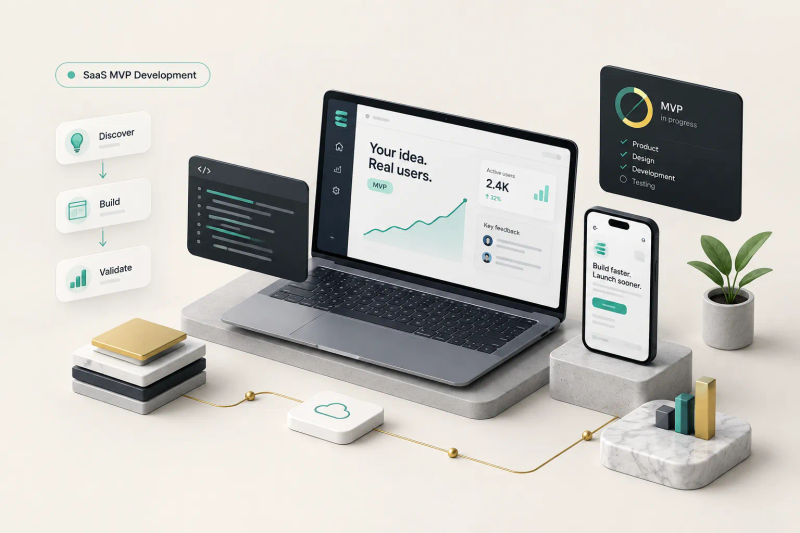
Most founders don’t fail because they picked the wrong tech stack. They fail because they built the wrong thing, or built the right thing with a partner who couldn’t execute. The difference between a successful minimum viable product and a $50K lesson in regret usually comes down to two decisions: what to validate before writing code, and who to trust with the build.
This guide gives you the concrete tools to make both decisions well. You’ll walk away with a decision matrix for choosing between no-code and full-code, scenario-based cost and timeline brackets, a 12-item RFP template with a weighted scoring rubric, a vendor interview script with red-flag answers, and an AI-integration checklist that most competing guides don’t even mention. Everything here is built for pre-seed to Series A founders, product managers, and technical co-founders who need to move fast on limited runway, and can’t afford to get this wrong.
Why Most MVPs Fail Before Launch
The biggest risk to your MVP isn’t a bug in production. It’s spending twelve weeks and $40K building a feature set nobody asked for. CB Insights data consistently shows that “no market need” kills more startups than any technical failure. The implication is uncomfortable but clear: your first job isn’t to build. It’s to prove that the problem you’re solving is real, painful, and worth paying to fix.
Before you talk to a single vendor, get precise about what you’re actually commissioning. Founders routinely confuse three things:
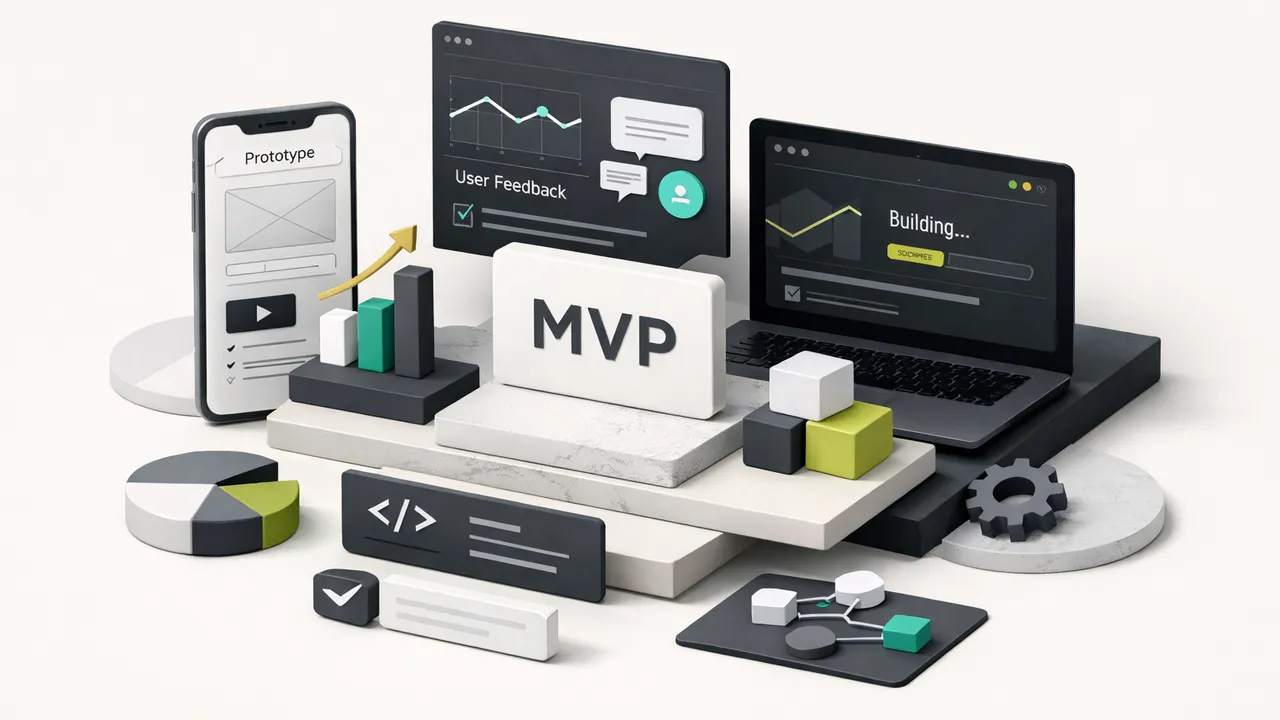
- Proof of concept: Can this be built? A technical spike that answers a feasibility question. No users touch it.
- Prototype: Does this feel right? A clickable prototype, often built in Figma, that tests flows and UI assumptions with real users before any backend exists.
- Minimum viable product: Does this solve a real problem for paying users? A functional product with one core user journey, instrumented to measure validated learning. This is the thing you ship.
If your vendor can’t articulate the difference between these three in the first call, that’s your first red flag.
This guide is for people hiring externally, not building in-house from day one. If you’re a non-technical founder who needs a trusted partner, a technical founder who needs execution speed, or a PM who needs an objective checklist to vet proposals and avoid wasted spend, everything that follows is designed for you. The tools ahead, decision matrix, RFP template, cost scenarios, interview script, AI checklist, are meant to be used, not just read.
Build It or Buy It First
The implementation path you choose shapes everything downstream: your budget, your timeline, your ability to iterate, and your risk of getting locked into a platform or vendor you can’t escape. Choosing wrong here doesn’t just cost money, it costs time-to-market, which is the one resource early-stage founders can never recover.
The No-Code vs Full-Code Decision
The no-code vs full-code question isn’t ideological. It’s strategic, and the right answer depends entirely on what you’re trying to learn and how fast you need to learn it.
When No-Code Wins
No-code tools like Bubble, Webflow, and Glide are the right choice when your primary goal is pure validation, testing demand, pricing, or workflow assumptions, and your product doesn’t require a technical moat. A marketplace landing page that captures signups. A simple booking flow. An internal tool for a sales team of fifteen. If you can validate your core hypothesis in four weeks for under $5K with no-code, do that first. The speed advantage is real: you can go from idea to testable product in days, not months.
But be honest about the ceiling. No-code tools create vendor lock-in by design. Your “app” lives on someone else’s infrastructure, built with someone else’s proprietary logic. When you hit the platform’s limits, and you will, usually around custom integrations, complex user roles, or performance at scale, you’ll rebuild from scratch. That’s not a bug in your plan. That’s the plan. No-code is a validation tool, not a production architecture.
When Full-Code Is Non-Negotiable
Full-code is non-negotiable when any of these are true: your product requires real-time data processing, AI integration with custom pipelines, compliance with healthcare or financial regulations, or performance-sensitive features like video, mapping, or offline-first behavior. It’s also the right call when you’ve already validated demand and need production-grade code that scales without a rewrite.
For most consumer and B2B mobile MVPs in 2026, cross-platform Flutter is the default sensible choice. A single codebase produces native-performance apps for iOS, Android, and web simultaneously, cutting build time and cost roughly in half compared to maintaining separate native codebases. Native iOS or Android development only makes sense when you’re accessing platform-specific hardware (ARKit, HealthKit integrations) or when raw performance in graphics-intensive applications is a hard requirement, not a preference.
| Item | Value |
|---|---|
| No-Code | $3K-$8K (2-4 weeks) |
| Flutter Cross-Platform | $15K-$60K (4-14 weeks) |
| Native (per platform) | $30K-$90K (8-20 weeks) |
Agency, Freelancer, or In-House?
Here’s the decision rule, stripped of nuance that doesn’t help you:
Freelancers suit tiny budgets (under $15K) and founders who can project-manage themselves. You’ll save on overhead but pay in coordination time. The hidden cost of mixing freelancers, a designer here, a backend dev there, a mobile dev somewhere else, is that nobody owns the architecture, and integration bugs become your problem. If you’re a technical co-founder comfortable running a distributed team, this can work. If you’re not, it usually doesn’t.
Agencies and product studios suit founders who need speed, accountability, and a single point of contact. A good studio handles product discovery, design, development, and QA under one roof. You’re paying a premium for that coordination, but coordination is exactly what kills MVP timelines when it’s missing.
In-house teams suit post-product-market-fit scaling. Hiring full-time engineers before you’ve validated demand is one of the most expensive mistakes a pre-seed founder can make. Average fully-loaded cost for a mid-level engineer in the US is $150K-$180K per year. That’s your entire seed round on one hire who might be building the wrong thing.
Regardless of which path you choose, flag vendor lock-in as a structural risk from day one. This isn’t just about pricing. It’s about whether you own your code, your accounts, your data, and your deployment pipeline when the engagement ends. The contract terms, IP transfer, source code escrow, access to cloud accounts, handover artifacts, matter as much as the build itself. We’ll cover exactly what to demand in the RFP section below.
What an MVP Actually Costs in 2026
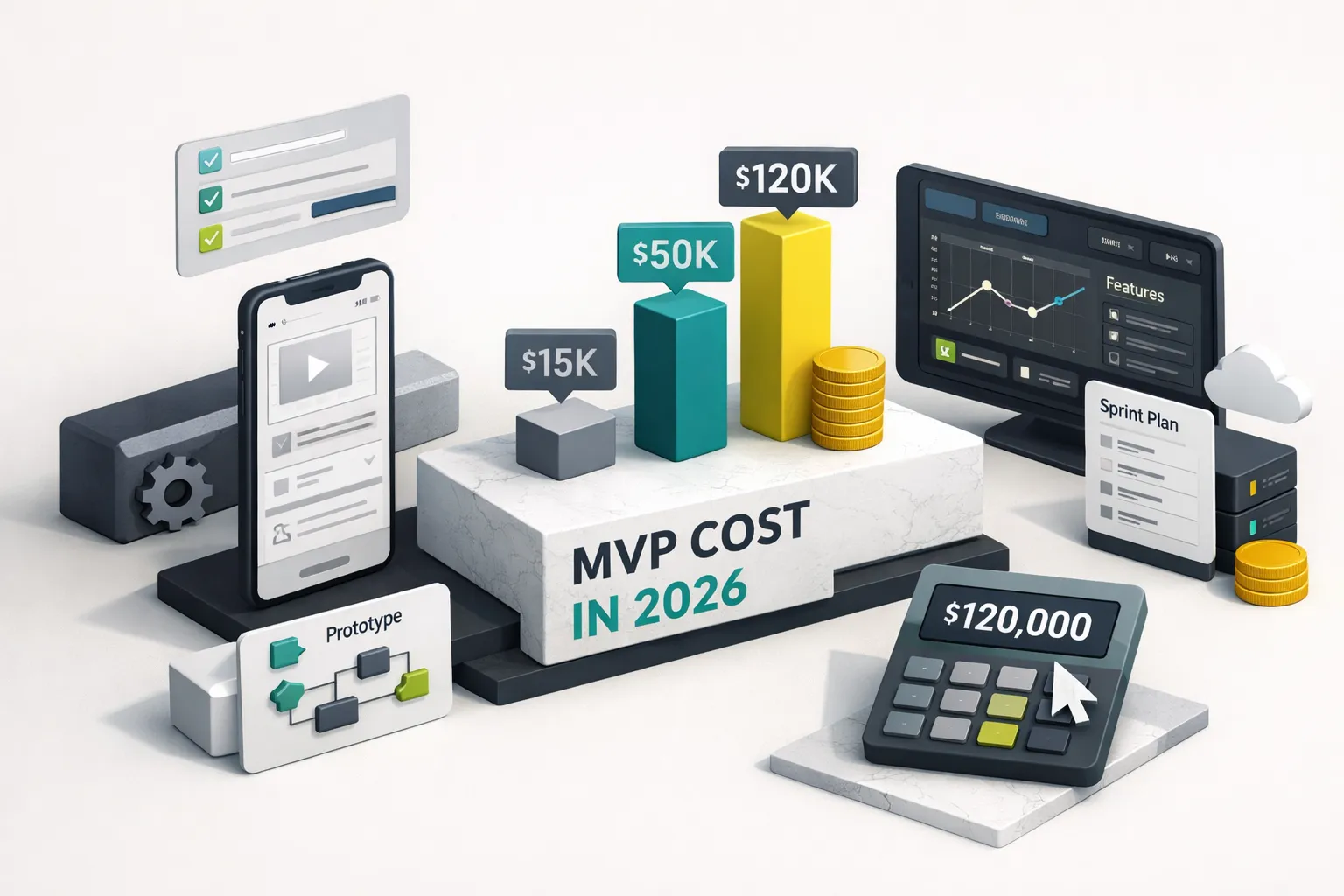
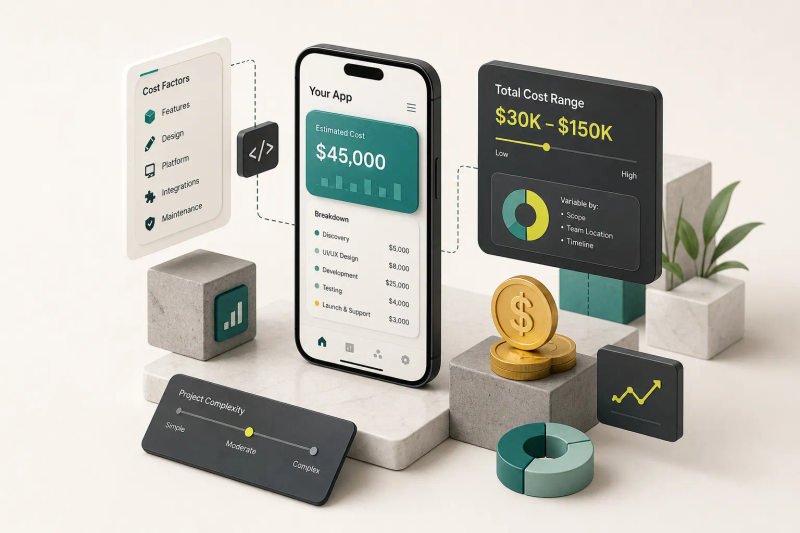
Vague cost ranges like “$10K to $500K” are useless. You need scenario-specific anchors that reflect what you’re actually building. Here are four realistic MVP types with illustrative cost and timeline brackets as of 2026. These aren’t guarantees, they’re calibrated starting points for your budgeting conversations.
Cost and Timeline by Scenario
| MVP Type | Cost Range | Timeline | Example |
|---|---|---|---|
| Simple consumer mobile app | $15K-$30K | 4-8 weeks | Habit tracker with push notifications, social sharing, basic analytics |
| B2B SaaS with auth, roles, dashboard | $30K-$60K | 8-14 weeks | Project management tool with team invites, role-based access, reporting dashboard |
| AI-integrated product (add-on to any base) | +$10K-$20K | +3-5 weeks | LLM-powered summarization, classification, or recommendation layer |
| Regulated (healthcare/fintech) | $60K-$120K+ | 16-24 weeks | Telehealth platform with HIPAA compliance, payment processing, audit logging |
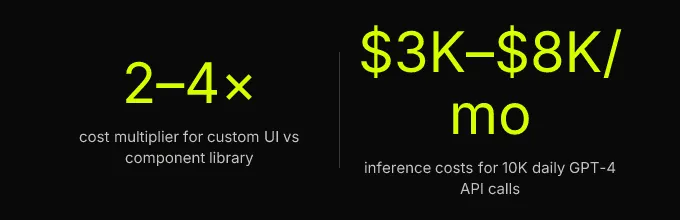
The AI line item deserves special attention. Adding an LLM-powered feature isn’t just “calling an API.” It involves designing data pipelines, managing inference latency, building fallback behavior, and budgeting for per-call costs that compound fast. A product making 10,000 GPT-4-class API calls per day can rack up $3K-$8K in monthly inference costs alone. Your vendor should model this before you sign.
What Drives the Price Up
Six factors explain most of the variance between a $15K MVP and a $120K one:
- Number of user roles. Every additional role (admin, manager, end user, guest) multiplies permission logic, UI states, and test cases.
- Third-party integrations. Each API integration (Stripe, Twilio, Salesforce, EHR systems) adds 1-3 weeks depending on documentation quality and auth complexity.
- Custom UI vs. template. A bespoke design system costs 2-4× more than adapting a component library. For an MVP, component libraries almost always win.
- Backend complexity. Real-time features, complex data relationships, and multi-tenant architectures push backend costs up significantly. The Firebase vs Supabase decision matters here, Firebase offers faster prototyping with more vendor lock-in; Supabase gives you Postgres underneath with more portability.
- AI inference costs. As noted above, these are operational expenses that persist after launch, not one-time build costs.
- Discovery inclusion. Some vendors include product discovery (user journey mapping, feature prioritization, clickable prototype) in the contract. Others bill it separately at $5K-$15K. Either is fine, but know which you’re getting.
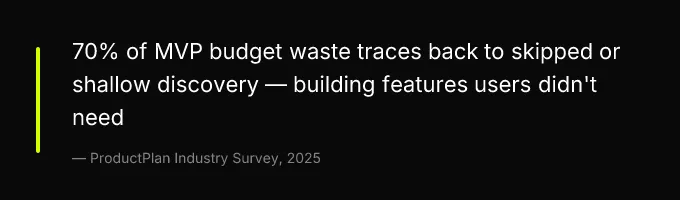
Without a locked scope document, fixed-price is meaningless because the vendor will simply cut corners to hit the number.
On contract structure: fixed-price contracts protect founders on limited runway. Time-and-materials contracts protect vendors against scope creep. The tension is real, and the resolution is a locked scope document, a detailed specification that both sides agree defines “done.” Without it, fixed-price is meaningless because the vendor will simply cut corners to hit the number. With it, fixed-price becomes the founder’s best protection against budget creep. Studios that operate on fixed scope with milestone-based walk-away guarantees, where you can exit after any milestone with your code and deliverables, represent what founder-protective contract structures look like in practice.
How to Vet and Select a Vendor
The difference between a great vendor and a mediocre one rarely shows up in their portfolio. It shows up in how they respond to a structured, demanding RFP, and how they answer hard questions under pressure. This section gives you both tools.
The 12-Item RFP Template
When you solicit proposals, include every one of these items. Each one exists because its absence creates a specific, predictable failure mode.
- Project summary, Two paragraphs max. What the product does, who it’s for, and why it matters. Forces you to be clear before asking anyone else to be.
- Success metrics, What does “working” look like? Define 2-3 measurable outcomes (e.g., 500 signups in 30 days, 20% Day-7 retention). Vendors who don’t ask about these aren’t thinking about product-market fit.
- User personas, Who are the first users? Be specific: “Operations managers at 50-200 person logistics companies,” not “businesses.”
- Core feature list, Prioritized using RICE or MoSCoW. Label each feature as must-have, should-have, or nice-to-have. This is your scope boundary.
- Platform targets, iOS, Android, web, all three? This drives the tech stack conversation.
- Tech stack preferences, State them if you have them. If you don’t, say so, a good vendor will recommend and justify.
- Timeline constraints, Hard deadlines (demo day, fundraise, seasonal launch) vs. flexible targets.
- Budget ceiling, Share it. Vendors who know your budget can design a scope that fits. Vendors who don’t will either overshoot or lowball.
- IP ownership requirement, State explicitly: “All source code, design files, and deployment configurations become our property upon payment.” Non-negotiable.
- Handover artifacts expected, Source code repository, CI/CD pipeline documentation, cloud account credentials, API keys, admin access, architecture diagrams.
- Reference contacts, Ask for two past clients you can call. Vendors who hesitate here are telling you something.
- AI-feature requirements, If applicable: what the AI does, what data it touches, expected call volume, latency tolerance, and compliance constraints.
Use a weighted scoring rubric to compare the proposals you get back. Here’s the weighting that works for most early-stage founders:
| Criterion | Weight | What You’re Evaluating |
|---|---|---|
| Technical credibility | 25% | Relevant stack experience, architecture quality in past projects, team composition |
| Product thinking & PMF understanding | 25% | Do they challenge your assumptions? Do they talk about users or just features? |
| Contract terms (IP, walk-away, handover) | 20% | Do they offer full IP transfer, milestone-based exits, and clean handover? |
| Communication & process transparency | 15% | Weekly demos? Shared project board? Named point of contact? |
| Cost & timeline realism | 15% | Does the proposal match the scenario brackets, or is it suspiciously cheap/fast? |
Score each vendor 1-5 on each criterion, multiply by weight, and compare totals. This protects you from defaulting to the cheapest proposal, which is almost never the best one.
Interview Questions That Reveal Red Flags
Ten questions to ask every vendor. The strong answers and red-flag answers are just as important as the questions themselves.
- “Walk me through a project where you pushed back on a client’s feature request.” Strong: specific story with reasoning and outcome. Red flag: “We build whatever the client wants.” That’s an order-taker, not a product partner.
- “Who owns the code if we stop after milestone one?” Strong: “You do, upon payment for completed milestones.” Red flag: any hesitation, conditions, or mention of licensing the code back to you.
- “How do you handle scope changes mid-project?” Strong: documented change-request process with cost/timeline impact assessment. Red flag: “We’re flexible” with no process described.
- “What does your discovery phase produce?” Strong: user journeys, clickable prototype, tech decision log, success metrics. Red flag: “We jump straight into development to save you time.”
- “Show me your instrumentation plan for a recent MVP.” Strong: specific analytics events, dashboards, and how data informed iteration. Red flag: “We add Google Analytics at the end.”
- “What’s your approach to technical debt in an MVP?” Strong: intentional tradeoffs documented in a tech debt register. Red flag: “We don’t cut corners” (everyone does in an MVP, the question is whether they’re conscious about it).
- “How do you handle AI integration, specifically hallucination risk and inference costs?” Strong: data flow diagram, output validation strategy, cost modeling. Red flag: “We just call the OpenAI API.”
- “What happens to our cloud accounts and API keys after handover?” Strong: everything is set up under your accounts from day one. Red flag: “We manage everything on our infrastructure.”
- “What’s your team structure for this project, and will the same people work on it start to finish?” Strong: named individuals with defined roles. Red flag: “We’ll assign the right resources”, that’s a bench-staffing agency, not a dedicated team.
- “Can I talk to a founder whose MVP you built in the last six months?” Strong: immediate yes with contact info. Red flag: NDAs preventing any references, or references only from projects three years old.
Discovery Deliverables to Demand
A serious vendor produces these before any code is written. If they skip product discovery and go straight to coding, they’re either cutting corners or they don’t understand what an MVP is for.
The minimum discovery deliverables are: documented user journeys for each persona (not just wireframes, the full path from awareness to core action to retention trigger), core success metrics tied to your business hypothesis, a clickable prototype tested with at least 3-5 representative users, a tech decision log with rationale for every major architecture choice (why Flutter over React Native, why Supabase over Firebase, why this auth provider), and a risk register identifying the top 5 technical and product risks with mitigation strategies.
This discovery phase is the single highest-ROI investment in your entire MVP process because it catches wrong assumptions before they become wrong code.
This discovery phase typically takes 2-3 weeks and costs $5K-$15K. It’s the single highest-ROI investment in your entire MVP process because it catches wrong assumptions before they become wrong code. Feature prioritization frameworks like RICE (Reach, Impact, Confidence, Effort) or MoSCoW (Must, Should, Could, Won’t) should be applied during this phase, not after development starts.
Building AI Into Your MVP Without Breaking It
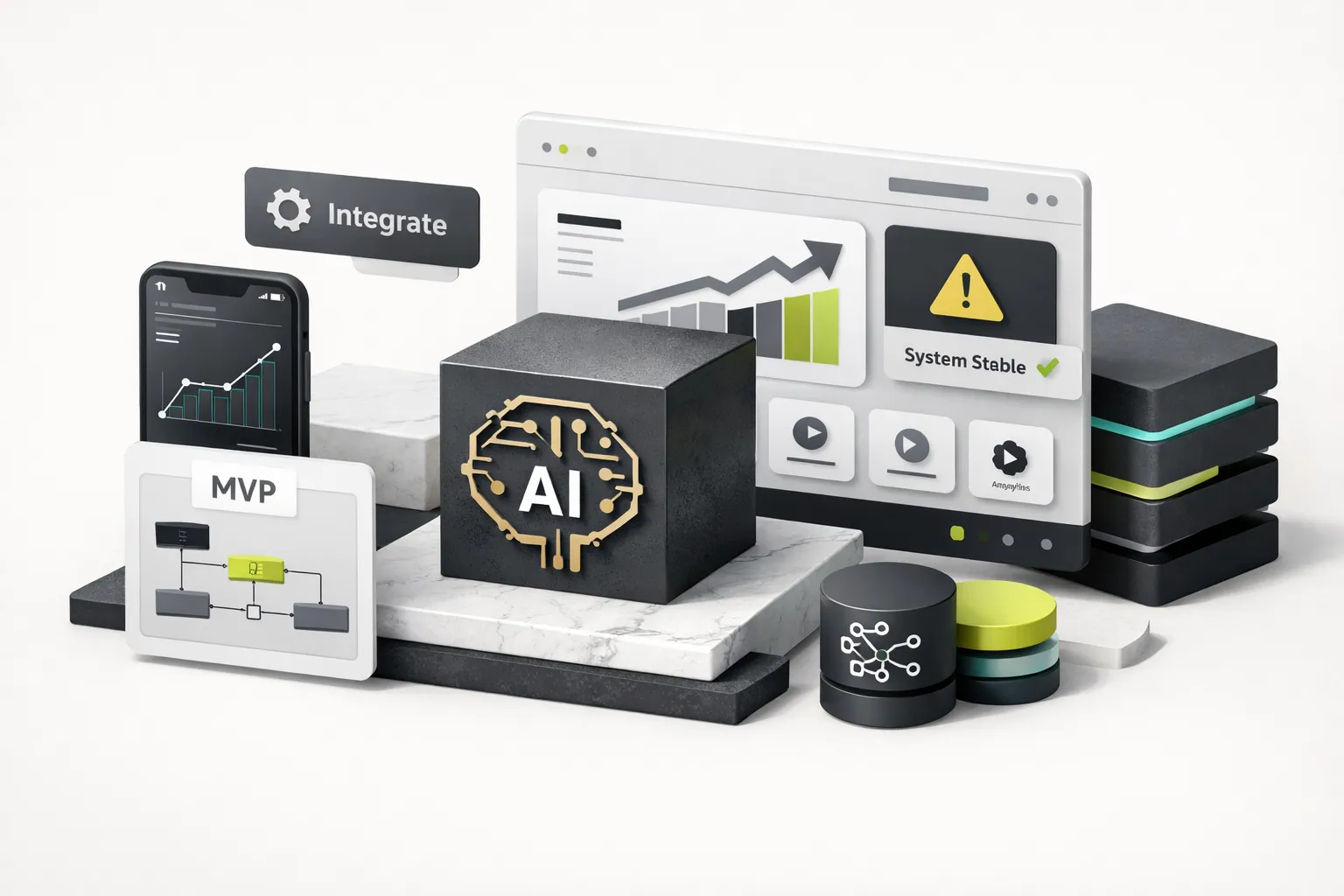
AI features in MVPs fail differently than regular features. A broken login screen is obvious. A hallucinating recommendation engine is insidious, it looks like it’s working while quietly destroying user trust. If your MVP includes AI, you need a vendor who treats it as a system design problem, not a checkbox.
Four failure modes are specific to AI in early-stage products. First, prompt costs compound at scale: what costs $50/month during testing can cost $5,000/month with 1,000 daily active users. Second, inference latency degrades UX: a 3-second wait for an AI response feels broken in a mobile app where users expect 200ms interactions. Third, hallucinations erode trust: one confidently wrong answer in a healthcare or finance context can kill your product’s reputation permanently. Fourth, data retention creates compliance exposure: if user data is sent to a third-party model API, you need to know exactly what’s stored, where, and for how long.
The AI Integration Checklist
Use this checklist to assess any vendor’s AI competence. If they can’t answer these six items clearly, they’re not ready to build AI into your product.
- Data flow diagram, What user data touches the model? Where is it processed? What’s stored vs. ephemeral?
- Latency budget per AI call, What’s the target response time? What’s the fallback behavior when the model is slow or unavailable? (Streaming responses, cached defaults, graceful degradation?)
- Hallucination mitigation strategy, Output validation rules, guardrails, confidence thresholds, and human review triggers for high-stakes outputs.
- Privacy and data retention policy, Does the third-party model provider (OpenAI, Anthropic, Google) retain input data? Is the vendor using the API tier that guarantees no training on your data?
- Cost-per-1K-calls estimate and monthly inference budget, Modeled at your projected user volume for months 1, 3, and 6 post-launch.
- Model versioning plan, What happens when the provider updates or deprecates the model you’re using? Is there a pinned version? A migration plan? Regression tests?
AI is a genuine force multiplier for MVPs when applied to the right problems: summarization, classification, personalization, content generation. But it’s a liability when bolted on without architecture thought. The backend and AI layer need to be designed together from discovery, not added in a sprint at the end because a pitch deck mentioned “AI-powered.” Vendors who treat AI as a marketing feature rather than an engineering discipline will cost you more than they save.
Your Next Step After Reading This
Here’s where you should be, depending on your stage:
If you’re pre-validation, don’t commission a full build yet. Start with a no-code prototype or a 2-week discovery sprint. Test your core hypothesis with real users before spending $30K+ on code. The cheapest MVP is the one you don’t build because you learned the idea needed to change.
If you’re post-validation with investor pressure, commission a fixed-price studio that offers full IP ownership, milestone-based walk-away clauses, and production-grade code. Cross-platform Flutter covers most mobile MVP needs at roughly half the cost of native. Lock the scope document before signing anything.
If your MVP includes AI features, make sure the vendor can answer every item on the AI integration checklist from this article before you sign. If they can’t explain their hallucination mitigation strategy or model their inference costs at your projected scale, they’re not ready.
The validation-first thesis that runs through this entire guide comes down to one principle: the best MVP development company is one that helps you define what not to build before writing a line of code. That discipline is rarer than technical skill, and it’s worth paying for.
Your concrete next step: take the 12-item RFP template and the scoring rubric from this article, send them to three vendors, and compare the responses side by side. The quality of the proposal will tell you more about the vendor than any portfolio page, case study, or sales call ever could.