Most guides about outsource software development companies give you a list of vendors ranked by Clutch score and call it a day. That’s not what this is. This is a playbook for CTOs, product founders, and procurement leads who need to ship fast and still own what gets built, the code, the architecture decisions, the ability to maintain it all after the vendor relationship ends.
What follows is the evaluation process, cost model, contract guidance, and governance framework that separates a successful outsourcing engagement from one that leaves you with a pile of unmaintainable code and a six-figure invoice. You’ll get a weighted vendor scorecard, realistic MVP cost bands for 2026, sample contract clause direction, and a 30/60/90 onboarding framework. The stuff competing guides skip.
Why Most Outsourcing Decisions Go Wrong
The failure pattern is remarkably consistent. A founder picks a vendor based on a polished portfolio and a competitive hourly rate. The contract is light on IP assignment specifics. The timeline estimate turns out to be aspirational. Three months in, the codebase has no automated tests, the vendor’s senior developer has rotated off to another client, and the founder realizes they don’t actually own the repository they’ve been paying for.
This isn’t a technical failure. It’s a structural one. The vendor selection process optimized for the wrong variables, aesthetics and price, instead of the ones that determine whether you’ll actually ship a product you can maintain: contract structure, handover quality, governance maturity, and alignment between the vendor’s delivery model and your ownership goals.
The core tension this guide resolves: speed-to-market and long-term product ownership are not mutually exclusive. But achieving both requires a fundamentally different evaluation process than browsing a top-ten list. You need to understand true total cost (not just hourly rates), know which contract clauses are non-negotiable, recognize the early warning signs of a derailing project, and have concrete benchmarks for what a realistic MVP timeline actually looks like in 2026. That’s what we’re covering, section by section.
Build In-House or Outsource?
Before evaluating outsource software development companies, you need to be honest about whether outsourcing is the right structural choice for your situation. The decision isn’t philosophical, it’s practical, and it hinges on three variables: how fast you need to move, how specific the capability gap is, and how long hiring would take relative to the project itself.
When Outsourcing Actually Wins
Outsourcing wins clearly in three scenarios. First, when speed-to-market matters more than institutional knowledge accumulation, you need an MVP in 6-10 weeks and your hiring pipeline takes 8-12 weeks just to fill one senior role. Second, when the capability gap is specific and bounded: you need Flutter cross-platform development or AI integration with MLOps, your team doesn’t have it, and you don’t need it permanently. Third, when the project is a discrete product bet, a new vertical, a proof-of-concept for investors, an internal tool, where the cost of a bad hire exceeds the cost of a bad vendor engagement.
If you need to build a long-term engineering culture, if the product is the company’s core IP and will require continuous iteration for years, or if regulatory constraints require all developers to be employees, build in-house. Outsourcing is a tool for bounded problems, not a permanent staffing strategy disguised as one.
Vendor Types and What They Actually Deliver
Product Studios vs. Agencies vs. Consulting Firms vs. Freelance Marketplaces
Most guides list these four categories without explaining why the distinction matters for your outcome. The distinction matters because vendor type determines pricing model, governance overhead, and handover quality, not just price.
Product studios (like CompletApp) operate with fixed scope, fixed price, and senior-only execution. They function as an extension of your product team, pushing back on bad scope decisions rather than billing for them. You get a defined deliverable with code ownership on payment. The trade-off: they’ll say no to poorly defined projects, which is actually a feature.
Boutique agencies typically run time-and-materials (T&M) engagements with dedicated teams of 3-8 people. They’re flexible but require more governance from your side. Good for ongoing feature development after an MVP ships.
Global consulting firms add project management layers, compliance documentation, and enterprise-grade processes. They’re appropriate when regulatory requirements demand it. They’re inappropriate for MVPs, you’ll spend more on coordination than on code.
Freelance marketplaces offer the lowest per-hour cost and the highest total cost of ownership. You become the project manager, the QA lead, and the architect. For a single, well-defined task (migrate this database, build this integration), freelancers work. For a product, they rarely do.
| Item | Value |
|---|---|
| Product Studio | Fixed scope + senior execution |
| Boutique Agency | T&M + dedicated team |
| Consulting Firm | Enterprise process + high overhead |
| Freelance Marketplace | Low hourly rate + high management cost |
The onshore vs. nearshore vs. offshore decision is simpler than most guides make it. Frame it around three variables: timezone overlap (do you need synchronous collaboration for sprint reviews and design decisions?), budget (offshore rates in Southeast Asia run 40-60% lower than US onshore), and data sensitivity (GDPR, HIPAA, or SOC 2 requirements may constrain where code is written and data is processed). For MVP speed specifically, nearshore often wins, you get meaningful cost savings with enough timezone overlap for daily standups and real-time Slack communication.
True Cost of an Outsourced MVP
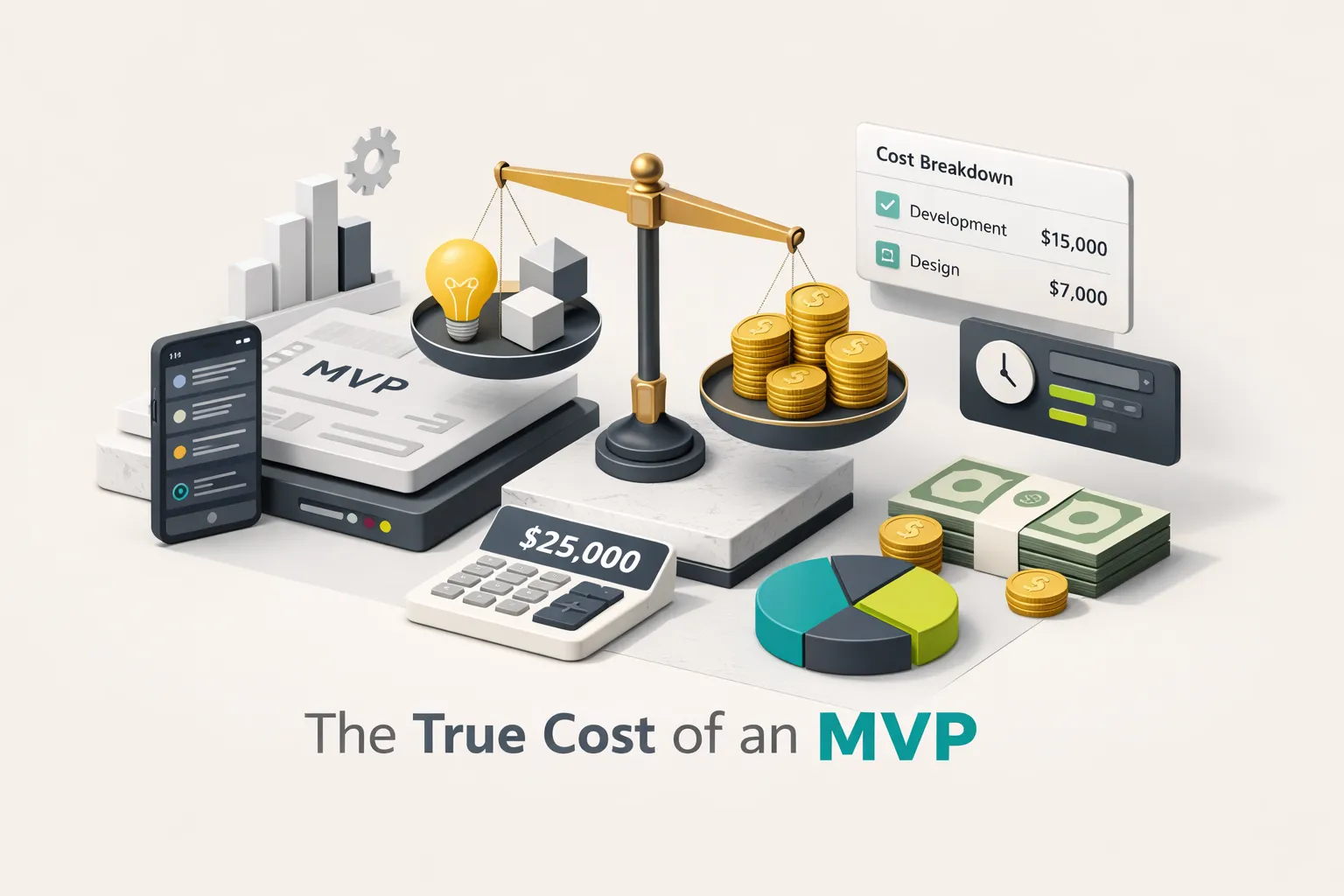
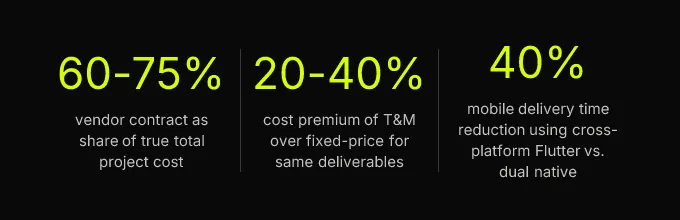
The number on the vendor’s proposal is not the cost of your project. It’s 60-75% of the cost of your project. Understanding this gap, and what fills it, is the difference between a budget that holds and one that blows up at month two.
The number on the vendor’s proposal is not the cost of your project. It’s 60-75% of the cost of your project.
Cost Bands by Complexity
As of 2026, here are realistic price and timeline ranges for outsourced MVPs, assuming a competent product studio or boutique agency using modern cross-platform stacks (Flutter for mobile, React with Firebase or Supabase for backend-as-a-service):
| Complexity Tier | Description | Timeline | Vendor Contract Cost |
|---|---|---|---|
| Small | Single-platform utility app, 3-5 screens, basic auth + data layer | 3-5 weeks | $15,000, $35,000 |
| Medium | Cross-platform app (Flutter), payment integration, one AI feature, 8-12 screens | 6-10 weeks | $40,000, $90,000 |
| Large | Multi-role SaaS with custom backend, admin panel, third-party integrations, AI pipeline | 10-16 weeks | $90,000, $200,000 |
These ranges assume fixed-price engagements with well-defined scope. T&M engagements for the same deliverables typically run 20-40% higher because the incentive structure rewards thoroughness over speed, and sometimes rewards slowness outright.
A vendor recommending separate native iOS and Android codebases for an MVP in 2026 is a yellow flag. Cross-platform Flutter development cuts mobile delivery time by roughly 40% compared to maintaining two native codebases, and the performance gap for most business applications is negligible. The vendor may be optimizing for billable hours, not for your outcome.
Hidden Costs Competitors Don’t Quantify
The gap between vendor contract value and true total cost of ownership comes from four sources that almost no competing guide quantifies:
Onboarding time. Your team will spend 15-30 hours in the first two weeks on architecture alignment, access provisioning, design system handoff, and requirements clarification. That’s internal salary cost that doesn’t appear on the vendor invoice.
Vendor management overhead. Sprint reviews, async Slack communication, scope clarification, and change order negotiation consume 5-10 hours per week of internal PM or founder time throughout the engagement. Over a 10-week project, that’s 50-100 hours.
Bug backlog cleanup. Poorly governed sprints produce code that ships with known issues deferred to “post-launch.” Cleaning up this backlog, either with the same vendor or a new one, typically costs 10-20% of the original contract value.
Knowledge transfer. When you switch vendors or bring development in-house, the receiving team needs 2-4 weeks of ramp-up time. If the outgoing vendor didn’t produce documentation, automated tests, or CI/CD pipeline configs, that ramp-up doubles.
The pricing model you choose determines who bears the risk of scope uncertainty. Fixed-price software development protects the buyer: the vendor absorbs the cost of estimation errors, which incentivizes them to scope carefully upfront. T&M shifts that risk to you, and rewards the vendor for every hour the project takes, including hours spent on rework. Outcome-based pricing (payment tied to user adoption or revenue milestones) is emerging for AI feature delivery but remains rare and requires sophisticated measurement infrastructure on both sides.
Evaluating Vendors Before You Sign
Vendor evaluation is where most outsourcing decisions are won or lost, and it’s where competing guides are weakest. They give you criteria, “check their portfolio,” “read reviews,” “ask about their process”, without giving you a structured way to score and compare. Here’s the structure.
The Weighted Vendor Scorecard
Score each vendor on five dimensions, weighted by how much each one affects your ability to own and maintain the product after the engagement ends:
| Dimension | Weight | What You’re Evaluating |
|---|---|---|
| Technical Fit | 30% | Stack alignment with your roadmap, test coverage standards (>80% unit test coverage as baseline), CI/CD maturity (automated deployments, not manual), DevOps practices |
| Handover Quality | 25% | Documentation standards, code ownership terms, dev environment setup scripts, runbook templates, willingness to do a paid handover sprint |
| Product Judgment | 20% | Can they push back on bad scope decisions? Do they ask “why” before “how”? Have they shipped products, not just features? |
| AI Capability | 15% | Production AI features (not prototypes), inference cost management, prompt versioning, model evaluation pipelines, MLOps maturity |
| Governance Maturity | 10% | Sprint cadence, DORA metrics tracking, transparent reporting, change order process |
The weighting logic: if you plan to bring code in-house (and most MVP-stage companies should), technical fit and handover quality together account for 55% of the score. A vendor with beautiful case studies but no documentation standards and no CI/CD pipeline will cost you more in the long run than a less flashy vendor who delivers maintainable, well-documented code.
Score each dimension 1-5, multiply by weight, sum the results. Any vendor scoring below 3.5 overall is a risk. Any vendor scoring below 3 on handover quality is a hard no if you plan to maintain the code yourself.
Assessing AI Capability (Not Just AI Hype)
Every vendor in 2026 claims AI capability. Most of them can wire up an OpenAI API call and put “AI-powered” on the landing page. That’s not what you’re evaluating. You’re evaluating whether they can build a maintainable AI feature, one that handles edge cases, manages inference costs, and doesn’t break when the model provider changes their API.
The questions that separate real AI capability from marketing:
- Show me a production AI feature you built that’s been live for more than 6 months. What’s the inference cost per user per month?
- How do you version prompts? Where are they stored, hardcoded, in a database, in a prompt management system?
- What happens when the AI returns a bad response? Show me the fallback handling.
- Do you have a model evaluation pipeline, or do you test prompts manually?
- Have you built data pipelines for fine-tuning or RAG, or do you only use off-the-shelf APIs?
A vendor who can answer these concretely, with examples, cost numbers, and architecture diagrams, has real AI integration and MLOps capability. A vendor who responds with generalities about “the power of AI” does not. This is the evaluation question competitors don’t teach buyers to ask, and it’s increasingly the question that determines whether your AI features survive contact with real users.
Contract Clauses That Actually Protect You
Most guides tell you to “make sure IP is covered in the contract.” That’s like telling someone to “make sure the parachute works” without explaining how to inspect it. Here’s what specific clauses should say:
IP assignment on payment. Intellectual property in all deliverables transfers to you upon payment of each milestone, not upon project completion. This protects you if the engagement ends early. A vendor unwilling to assign IP on payment is a structural red flag. They’re retaining leverage they shouldn’t need if they’re confident in their delivery.
Source code escrow. For projects longer than 8 weeks, require that source code be deposited in escrow (GitHub private repo with your admin access, or a third-party escrow service) at the end of each sprint. You should never be more than two weeks away from having access to your own code.
Termination for convenience with code delivery. You can terminate the contract at any time with 14 days’ notice. Upon termination, the vendor delivers all source code, documentation, environment configs, and credentials within 5 business days. Without this clause, you have no exit ramp.
Data processing agreement. If the vendor handles user data, GDPR or equivalent data security and NDA requirements apply. The contract should specify where data is stored, who has access, retention periods, and breach notification timelines.
Non-solicitation of key personnel. A 12-month non-solicitation clause prevents the vendor from pulling the lead developer off your project to staff a higher-paying client. This is standard but frequently omitted from template contracts.
CompletApp’s fixed-scope, fixed-price model includes 100% code ownership on payment as a default contract term, not as an add-on or negotiation outcome. That’s worth noting not as a sales pitch but as a benchmark: this is what buyer-protective contracts look like in practice. If your vendor’s proposal doesn’t include these protections, ask why.
Onboarding, Governance, and Knowing When to Worry
Signing the contract is the beginning of the risk management process, not the end of it. How you onboard the vendor team, what you measure during the engagement, and how quickly you recognize warning signals determines whether you get a product or a problem.
The 30/60/90 Onboarding Framework
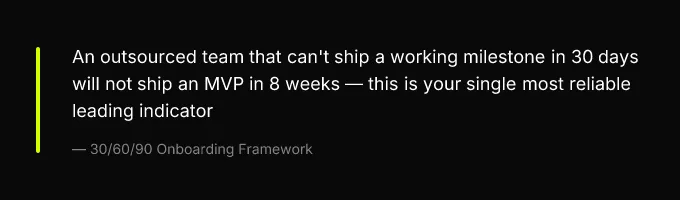
Days 1-30: Prove the engine works. Environment setup and access provisioning should be complete by day 3. Architecture alignment, stack decisions, database schema approach, API design patterns, deployment target, by day 7. The vendor should deliver a working first milestone (not a mockup, not a design, working code deployed to a staging environment) by day 30. An outsourced team that can’t ship a working milestone in 30 days will not ship an MVP in 8 weeks. This is your single most reliable leading indicator.
Days 31-60: Establish cadence. Sprint cadence should be locked in, typically two-week sprints with a demo at the end of each. Run the first retrospective. Baseline velocity so you can detect deceleration. By day 60, you should have a clear, data-backed answer to the question: “Are we on track to deliver the full scope by the target date?”
Days 61-90: Prepare for independence. Conduct a handover readiness review. Audit documentation: does a developer handover checklist exist? Are there automated tests? Is the CI/CD pipeline documented? Is there a runbook for production incidents? This is your go/no-go decision point on whether to continue the engagement, extend it, or transition to internal maintenance.
KPIs and Early Warning Signals
Require these metrics in weekly reporting, and insist on them from week one, not as a nice-to-have after the project is underway:
Engineering health (DORA metrics): deployment frequency (target: multiple times per week), lead time for changes (target: under 24 hours), change failure rate (target: under 15%), and mean time to recovery (target: under 1 hour). These four DORA metrics tell you whether the team is shipping reliably or accumulating technical debt behind a facade of “progress.”
Delivery predictability: sprint commitment accuracy (what percentage of committed stories actually ship?) and velocity trend (is it stable, increasing, or declining?). A declining velocity trend after week 4 means the codebase is getting harder to work in, a sign of architectural problems or accumulating shortcuts.
Quality: bug escape rate, how many defects are found in production vs. caught in testing? A rate above 20% means the test suite is inadequate or nonexistent.
These are better than “hours logged” or “tasks completed”, the metrics most vendors default to, because they measure outcomes, not activity.
Early warning signals that a project is derailing:
- Scope additions without change order documentation. The vendor agrees to “small additions” verbally. These accumulate. The timeline slips. Nobody can point to when the scope changed because it was never written down.
- Sprint reviews replaced by status emails. When a vendor stops showing working software and starts sending bullet-point updates, they’re hiding something, usually that the software isn’t working.
- No automated test suite after week 3. If tests aren’t being written alongside features from the start, they won’t exist at handover. You’ll inherit untestable code.
- Reluctance to share repository access. You should have read access to the repo from day one. Any hesitation here is a red flag for IP ownership issues downstream.
If these don’t exist at handover, you haven’t received a product. You’ve received technical debt with a user interface on top.
On handover specifically: the outsourced team should deliver a working local dev environment setup script (one command to get a new developer running), a README that a mid-level engineer can follow without calling the original team, CI/CD pipeline documentation with DevOps and CI/CD configs committed to the repo, and a runbook for production incidents covering the five most common failure modes. If these don’t exist at handover, you haven’t received a product. You’ve received technical debt with a user interface on top.
The Decision That Protects Your Product Long-Term
The right vendor model depends on what you’re building and what happens after it ships. If you need an MVP in under 8 weeks with a fixed budget and full code ownership at the end, a fixed-scope product studio is the structurally correct choice, the incentives align, the risk allocation is clear, and the handover is built into the delivery model. If you need ongoing feature development with a flexible team, a nearshore boutique on T&M with strong governance (DORA metrics, sprint demos, documented change orders) is more appropriate. If you need enterprise compliance certification and cost is secondary, a global consulting firm may fit.
One principle holds across all three: the vendor who is most transparent about what they won’t do is almost always safer than the vendor who says yes to everything. Scope honesty at the proposal stage predicts handover quality at the finish line. A vendor who tells you “this feature doesn’t belong in an MVP” or “this timeline requires cutting these three items” is showing you exactly the kind of product judgment that prevents the structural failures we’ve been talking about.
If you want to see what a transparent scoping conversation looks like in practice, CompletApp’s discovery call is a 30-minute conversation that ends with a written proposal, scope, price, timeline, and what’s explicitly excluded. Not a sales cycle. Not a “let’s circle back.” A decision you can evaluate against the scorecard you now have.