Why This Is Different From Building an App
Most founders arrive with a competitor’s app open on their phone and a feature list scraped from its onboarding flow.
That list is the wrong starting document.
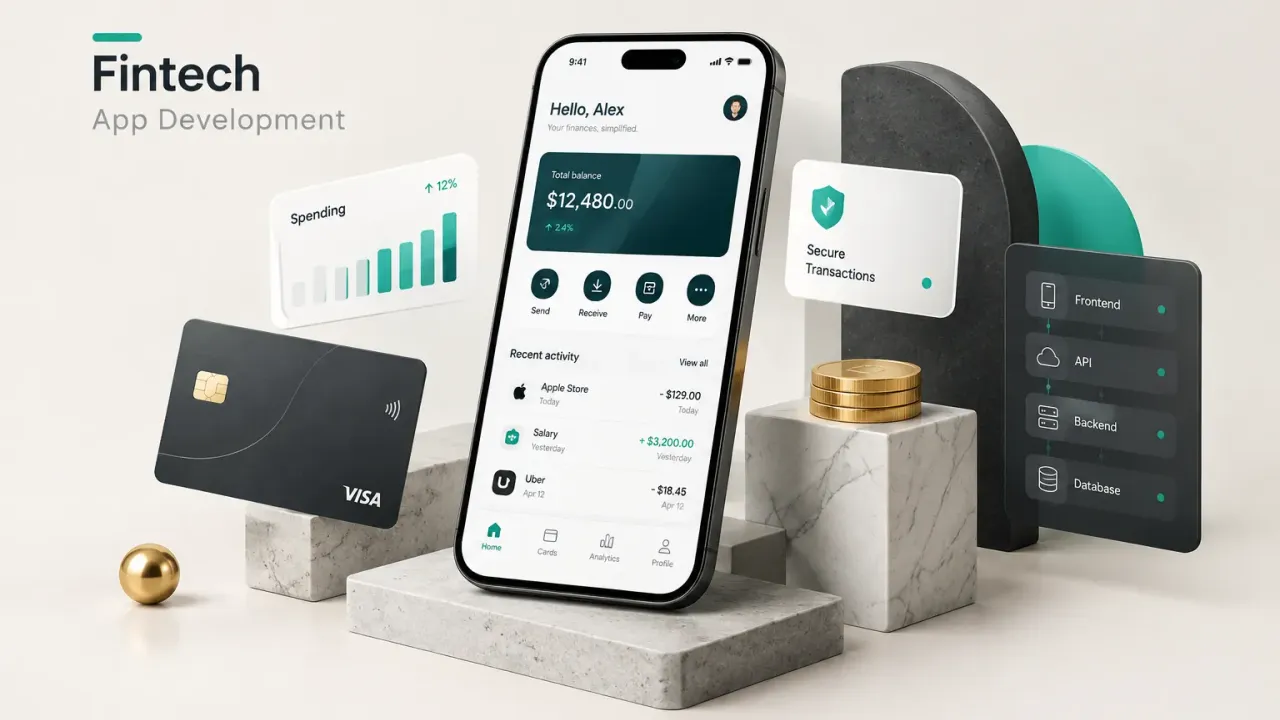
Fintech app development is a compliance discipline with an engineering department attached, not a product build with a legal review bolted on at the end.
The screens are the easy part.
What sits behind them, custody of funds, identity verification, ledger integrity, decides whether you ship in eight weeks or eighteen months.
The rules also move underneath you.
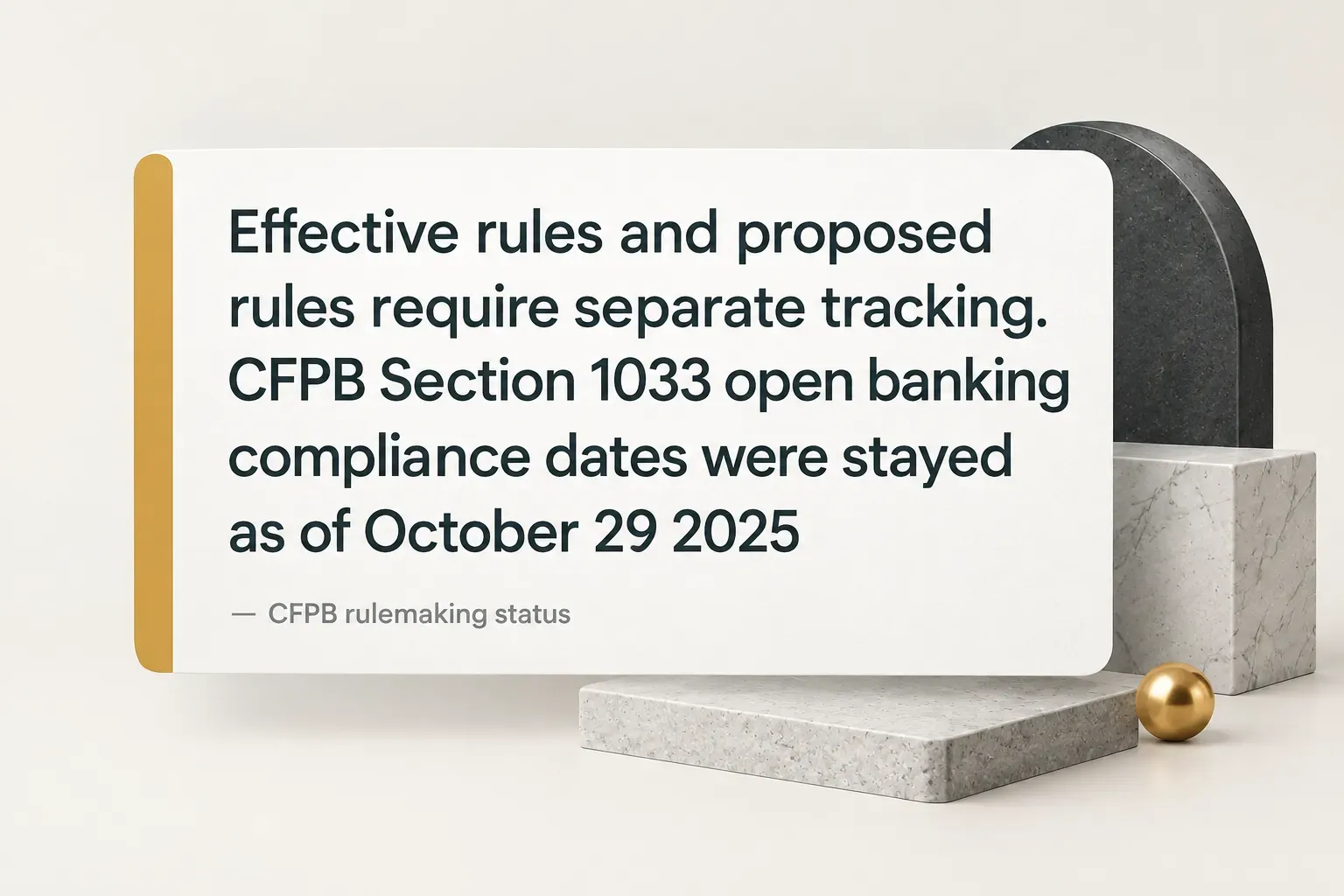
The CFPB’s open banking rule under Section 1033 is a good example: compliance dates were stayed as of October 29, 2025, leaving the industry building against a standard that exists on paper but not yet on a deadline. Effective rules and proposed rules are two different planning inputs, and teams that blur them either over-build for requirements that never landed or under-build for ones that already did.
Throughout this guide, two responsibilities stay separate.
Regulatory counsel owns legal interpretation and licensing strategy. Your development team owns technical implementation: architecture, encryption, KYC and AML plumbing, transaction ledger correctness.
Confusing the two is how startups end up with a beautiful mobile banking interface and no lawful way to move money.
The core thesis is simple.
Product scope determines regulatory exposure.
Regulatory exposure determines architecture, security posture, and launch timeline. Payments, custody, and lending each pull you into a different tier of obligation, and you cannot pick the architecture before you have honestly scoped the activity.
Why Fintech App Types Aren’t Equal
A budgeting app that reads bank balances and a wallet that holds customer money are not the same product with different features.
They are different businesses that happen to share a UI framework.
Scope Decides Regulatory Exposure
The single biggest variable is custody: does money ever sit in an account you control?
Read-only aggregation via open banking APIs keeps you in data-protection territory.
Holding balances drags you into money transmission, safeguarding, and reconciliation obligations that never end.
Lending and insurance add a second axis entirely.
Once your software makes a decision about a person, approve or decline, price or exclude, you inherit fair-lending, adverse-action, and model-governance requirements that a payments app never touches.
| App type | Primary regulatory concern | Holds customer funds? | Typical integrations | MVP complexity |
|---|---|---|---|---|
| Personal finance / budgeting | Data privacy, consent, open banking access rules | No | Aggregators (Plaid, TrueLayer, Salt Edge), analytics | Low |
| Payments / wallet | Money transmission, PCI DSS, AML transaction monitoring | Often yes (stored balance) | Payment processors, card networks, tokenization SDKs | High |
| Neobank | Banking partnership oversight, safeguarding, KYC and AML | Yes, via sponsor bank | Banking-as-a-service, card issuing, KYC vendors, ledger | Very high |
| Lending / BNPL | Licensing, fair lending, adverse action, disclosure rules | Disbursement and repayment flows | Bureaus, decisioning engines, ACH/rails, servicing | Very high |
| Investing / wealth | Securities regulation, suitability, custody of assets | Yes (assets under custody) | Broker-dealer APIs, market data, custodians | Very high |
| Insurance / insurtech | Underwriting rules, product licensing, claims conduct | Premiums and claims payouts | Carrier APIs, rating engines, document capture | High |
| Remittances / cross-border | Money transmitter licensing per corridor, sanctions screening | Yes, in transit | FX providers, local rails, sanctions lists, compliance tooling | Very high |
| Accounting / invoicing | Data protection, tax reporting accuracy, e-invoicing rules | Usually no | Aggregators, accounting APIs, tax engines, payment links | Low to medium |
Read the table as a discovery instrument.
It tells you which questions to ask and roughly how deep the build goes, not what your legal obligations are in a specific state, country, or corridor.
Two apps in the same row can land in completely different places depending on jurisdiction. A wallet serving one domestic market under a partner’s license is a different regulatory animal from the same wallet operating across four countries.
Jurisdiction-specific legal review is not optional, and this matrix does not replace it.
From Idea to Working Architecture
The order of operations matters more in fintech than almost anywhere else in software.
Build the integration layer before the compliance review and you will rebuild it.
Here is the sequence that actually holds up.
- Discovery and scoping. Define the exact financial activity, jurisdictions, and whether funds are ever held. This single workshop determines every downstream cost, so do it with counsel in the room, not after.
- Architecture design and threat modeling. Map data flows, trust boundaries, and failure scenarios before a line of production code exists. Threat modeling at this stage costs days; retrofitting it costs quarters.
- Core MVP build. Ship the value loop only: authentication, tiered identity verification, one payment rail, balance view, notifications. Everything else waits.
- Integration layer. Wire aggregators, processors, or banking-as-a-service providers behind your own abstraction so no vendor’s schema leaks into your domain model.
- Compliance review. Counsel reviews flows, disclosures, consent screens, and data retention against the licensing model you chose in step one.
- Security testing. Independent penetration testing, mobile hardening against OWASP MASVS, and a full review of secure key management before any real money moves.
- Launch, controlled. Feature flags, kill switches, a small cohort, and monitoring dashboards live from day one.
- Iterate on evidence. Separate product signals from risk signals and expand scope only when both are stable.
MVP Features That Matter
A fintech MVP is not a small version of the roadmap.
It is the shortest complete path from signup to a successful transaction, instrumented well enough to prove people want it.
Keep these: account creation with OAuth 2.0 and OpenID Connect where relevant, a tiered KYC step that only escalates verification when a user crosses a risk or value threshold, one payment rail, a real balance and transaction ledger view, and transactional notifications.
Defer these without guilt: multi-currency, referral programs, rewards, in-app chat, advanced analytics dashboards, a second payment rail, card issuing, and anything involving a second jurisdiction.
Each one multiplies compliance surface, not just development hours.
Connecting to Banks and Processors
Design the backend so vendors are replaceable.
A backend-for-frontend layer serves the mobile client exactly what it needs, while a separate service layer holds business logic and speaks to external APIs through adapters. When a provider deprecates a version or you switch aggregators, you change one adapter.
Money settles asynchronously.
That reality makes event-driven handling mandatory: webhooks arrive out of order, arrive twice, or arrive four hours late, and your system has to stay correct through all three.
Three categories of partner solve three different problems:
- Data aggregators (Plaid, TrueLayer, Salt Edge) give you read access to accounts, balances, and transactions through open banking APIs. Right for budgeting, accounting, and underwriting inputs. They do not move money.
- Payment processors (Stripe, card networks, ACH/SEPA providers) execute the movement of funds and handle payment tokenization so raw card numbers never touch your servers. Right for checkout, payouts, and subscription billing.
- Banking-as-a-service middleware provides accounts, ledgers, card issuing, and a sponsor-bank relationship. Right for neobank and embedded finance products where you need account infrastructure without a banking licence of your own.
Flutter, Native, or Both?
A shared Flutter codebase handles the overwhelming majority of a fintech client: onboarding flows, dashboards, transaction lists, transfer forms, settings, state management, and business logic.
Two platforms, one team, one set of bugs.
For an MVP racing to validate demand, that is a meaningful advantage.
Where it stops being enough is at the hardware boundary.
Secure enclave and hardware-backed keystore access, certain tokenization SDKs, advanced biometric authentication flows, and platform attestation generally require native modules and platform-specific security review. Plan for a thin native layer rather than pretending it will not exist.
A cross-platform client with native security modules is not a compromise. It is the standard architecture for most consumer financial technology apps shipping in 2026.
CompletApp’s approach, Flutter on the client with Firebase or Supabase for backend services and Stripe for payments, is one practical way to get a cross-platform MVP live on fixed milestones.
It fits validation-stage products with a clear value loop.
It does not fit every case: high-frequency trading interfaces, deep hardware integrations, or ledger systems requiring very high throughput justify a different stack entirely.
Where Regulation Actually Applies
Regulators do not care what you call your app.
They care what it does.
This section is not legal advice.
Qualified regulatory counsel must confirm licensing requirements before launch. Developers own technical implementation; counsel owns legal interpretation.
Where those two conversations stay separate, projects move fast.
Where they merge, someone ends up guessing.
Regulations Mapped to Your Activity
Obligations attach to activities, not categories.
Work through each of these during discovery:
- Activities performed. Moving funds, holding funds, extending credit, exchanging currency, and distributing insurance each trigger distinct licensing regimes.
- Jurisdictions served. Requirements stack per country and, in the US, frequently per state. Serving users in five markets can mean five compliance programs.
- Data handled. Card data pulls in PCI DSS. Personal data pulls in GDPR, CCPA, or local equivalents, with data minimization and privacy by design as defensible defaults.
- Payment flows. Card, ACH, SEPA, instant rails, and crypto each carry their own rulebooks, dispute mechanics, and settlement timing.
- Custody of funds. Safeguarding, segregation of client money, and reconciliation duties begin the moment a balance exists.
- Lending decisions. Automated decisioning brings adverse-action notices, fair-lending testing, and model documentation requirements.
- Use of regulated partners. Operating under someone else’s licence reduces your direct exposure but subjects you to their program management rules and oversight.
Infrastructure Partner or Regulated Entity
This is the fork in the road that sets your timeline.
Integrating with a licensed banking-as-a-service provider or payment processor means you operate inside their program: faster to market, lower legal spend, less control over pricing, features, and offboarding.
Becoming the regulated money transmitter yourself means direct licensing, capital requirements, and examinations, in exchange for margin and independence.
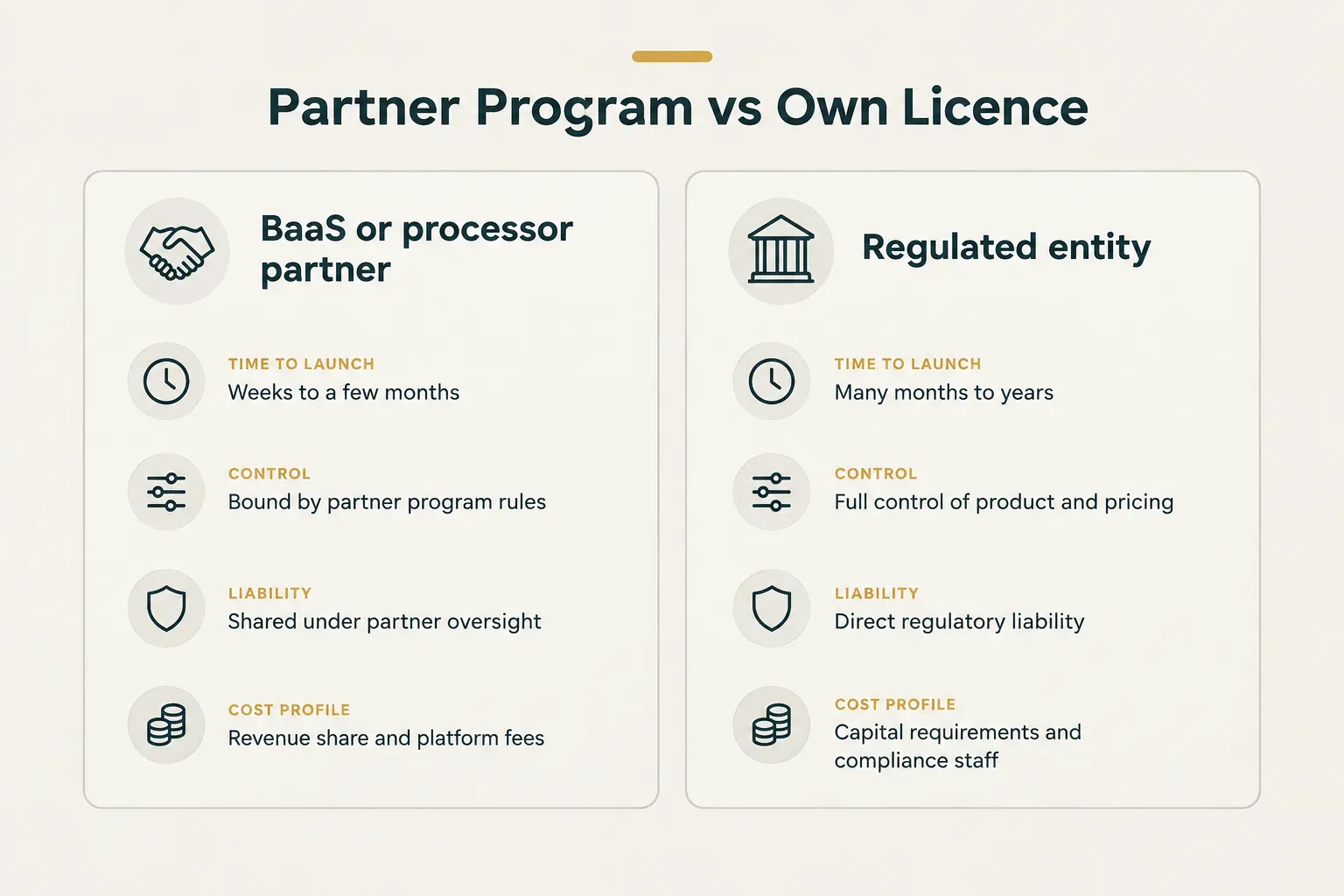
Partnering does not eliminate risk, it relocates it.
Service-provider risk management becomes your job:
- Vendor due diligence on financial stability, licensing status, security certifications, and track record of sudden program terminations.
- Data-processing agreements that define who controls what data, where it resides, and under what legal basis it moves across borders.
- Incident notification SLAs with explicit hours-to-notify, because you cannot meet your own breach deadlines if your vendor takes a week.
- Data export and exit plans tested at least once, not theorised in a contract clause. Can you retrieve your full transaction ledger and customer records in a usable format?
- Concentration risk assessment. One provider handling accounts, cards, KYC, and payouts is a single point of failure for your entire business.
Implementing KYC and AML
KYC and AML are product features, not a compliance PDF.
Users feel them at onboarding, and badly built verification is one of the largest sources of drop-off in mobile banking apps.
- Identity verification vendor integration handling document capture, liveness checks, and database verification, with clear retry paths for failed scans.
- Risk-based tiered KYC that supports a minimal customer identification program at signup and escalates evidence requirements as balances, velocity, or geography increase.
- Ongoing transaction monitoring with rules tuned to your actual product behaviour, not vendor defaults that flag half your legitimate users.
- Sanctions and PEP screening at onboarding and continuously thereafter, since list updates can turn an existing customer into a match overnight.
- A human escalation path for suspicious activity, with case management, documented decisions, and an audit trail that survives an examination.
Security and Financial Correctness
Security failures make headlines.
Ledger failures quietly destroy companies.
You need both handled, and they require different engineering habits.
Encrypting What Matters Most
Blanket encryption is table stakes.
Precision is what separates a defensible architecture from a checkbox one.
- Encryption at rest and in transit everywhere, TLS 1.3 on the wire, with certificate pinning on the mobile client to blunt interception attacks.
- Field-level encryption for PII and sensitive financial identifiers, so a database dump does not equal a data breach of readable records.
- Payment tokenization instead of storage. Never store raw PANs. Let the processor hold card data and keep your PCI DSS scope as narrow as it can possibly be.
- Secure key management through a KMS or HSM, with documented rotation schedules, split duties, and no keys in environment files or source control.
- Biometric authentication with a non-biometric fallback, backed by multi-factor authentication and a defined, abuse-resistant account recovery flow. Recovery is where most account takeovers actually happen.
Ledgers, Idempotency, and Safe Failure
Ask a fintech engineer what keeps them up at night and you rarely hear “hackers”.
You hear “duplicate payments”.
Networks time out, users tap twice, webhooks replay, and a naive system pays twice.
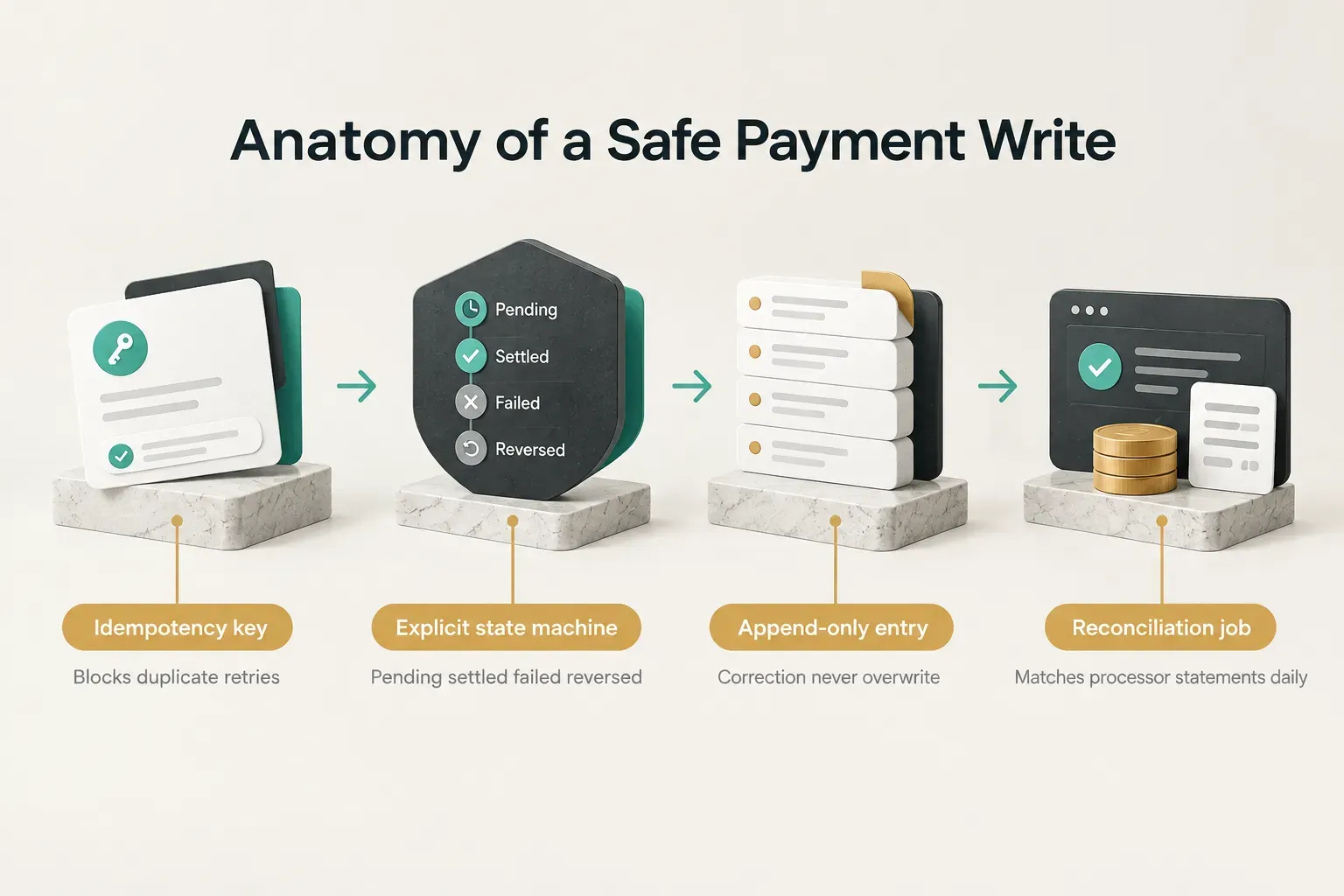
- Append-only transaction history. Records are never edited or deleted. Corrections are new entries that reference the original, preserving a complete audit trail.
- Double-entry bookkeeping or a subledger design so every movement has a matched debit and credit and your balances can always be derived, never guessed.
- Idempotency keys on every write that moves money, so a retried request returns the original result instead of creating a second payment.
- Explicit transaction states: pending, settled, failed, reversed. Implicit states are how money goes missing in support tickets.
- Payment reconciliation against processor and bank statements on a scheduled cadence, with breaks surfaced as alerts rather than discovered at month end.
- Chargeback, refund, and reversal handling modelled as first-class flows with their own states, notifications, and accounting treatment.
- Circuit breakers and retry queues for the inevitable outage of a bank API, processor, identity vendor, or webhook endpoint. Fail closed on money movement, fail open on read-only features.
If you apply AI to risk scoring, fraud detection, or support automation, govern it.
No autonomous financial approvals without human review, documented explainability for any decision affecting a customer’s access to funds or credit, and strict data minimization in what gets sent to a model.
Regulators are increasingly direct about this, and “the model decided” has never been an acceptable answer in an adverse-action dispute.
Testing Beyond the Sandbox
Sandbox environments are optimistic liars.
They respond instantly, never rate-limit you, and return clean success payloads.
Production does none of that.
- Contract testing against provider API versions so a silent schema change in a processor update is caught by CI, not by a customer.
- Webhook retry and replay testing: deliver events twice, out of order, and hours late, then verify your ledger is still correct.
- Synthetic transaction monitoring in production, running small real transactions on a schedule to prove the full path works right now.
- Reconciliation testing with deliberately injected mismatches to confirm breaks are detected and alerted, not absorbed.
- Rate-limit and outage drills. Kill the identity vendor in staging. Watch what the onboarding flow does. Fix what you see.
- Independent penetration testing before launch, with mobile testing mapped to OWASP MASVS and remediation verified by retest.
Post-launch, operational readiness is the product.
Real-time monitoring, immutable audit trails, fraud alerts routed to a named human, a documented support escalation workflow, feature flags and kill switches on every money-moving path, and database migrations run behind controlled, reversible steps.
Then measure two different things and never average them together.
Product-market fit signals: activation rate, retention, transactions per active user. Risk and reliability signals: authentication failure rate, fraud rate, false-positive rate, payment success rate, reconciliation breaks, API latency, crash-free sessions, and support escalation rate.
Great retention with a rising false-positive rate is not success.
It is a countdown.
Your Next Move
The decision is cleaner than it looks.
If you are validating demand and never touching customer funds, use aggregator and banking-as-a-service partners with a lean cross-platform stack and ship in weeks.
If you handle custody or make lending decisions, budget for licensing counsel and compliance-grade architecture before anyone writes production code.
The most common and most expensive mistake is treating compliance and financial correctness as post-launch additions. Idempotency, double-entry ledgers, audit trails, and KYC tiering are day-one architecture decisions.
Retrofitting them means rewriting the system you just paid for.
So do this first: map every regulatory obligation and every failure scenario during discovery. Every vendor outage, every duplicate webhook, every declined verification.
Then, and only then, commit to a stack and a launch date.