Why This Decision Is Harder Than It Looks
Search for a fitness app development company and you get two things: listicles of agencies that paid to be listed, and cost tables with ranges so wide they’re useless.
“$30,000 to $300,000.”
Thanks.
What almost nobody explains is the set of decisions you need to make before you talk to a single vendor. Because the quote you receive is just a mirror of the assumptions you brought to the call.
Two founders can describe “a workout tracking app” and mean entirely different products. One needs a single screen that logs sets and reps. The other needs trainer portals, video streaming, Whoop integration, and subscription billing across two platforms.
Same sentence.
Ten times the budget.
This guide covers the things that actually change the outcome: the eight categories of fitness apps and why each needs different infrastructure, what genuinely drives cost and timeline, how to cut a fitness app MVP down to one value loop, the technical tradeoffs around native versus cross-platform and wearable device integration, where AI belongs, and what compliance and code ownership look like in practice.
It ends with post-launch metrics, because launching is not the finish line. It’s the point where you start learning whether anyone comes back on week four.
Read this before a sales call, not during one. The goal is to walk in with a scope you can defend and a list of questions a good studio will respect.
What a Fitness App Development Company Does
A real development partner does far more than write code.
The engineering is maybe 45% of the work. The rest is deciding what to build, what to cut, and how it holds up after 10,000 people install it.
Here’s what a full-service studio owns end to end:
- Product strategy and discovery. Turning a business goal into a feature set, defining the core value loop, and mapping the monetization model before a single screen gets designed. This phase is where budgets get saved or wasted.
- UX/UI design. Wireframes, user flows, user onboarding sequences, and a visual system that works on a 5.4-inch phone at the gym with sweaty hands. Good fitness UX means fewer taps during a workout, not prettier gradients.
- Cross-platform or native engineering. Building the client app, handling offline state, sensor access, background tasks, and animation performance. One codebase or two, depending on the decision covered later.
- Backend and API integration. User accounts, data models, fitness app API layers, third-party connections to health platforms and payment providers, and the infrastructure that keeps activity data synchronization reliable.
- QA and device testing. Real-device testing across OS versions, edge cases around permissions, and regression testing before every release. Not just “it works on the developer’s iPhone.”
- App-store deployment. Store listings, review compliance, privacy manifests, subscription configuration, and handling rejections. Apple rejects health apps for vague data-use disclosures constantly.
- Post-launch support. Crash monitoring, app maintenance and support, OS update compatibility, and iteration based on real usage data.
Now compare your options.
A full-stack studio owns discovery through launch with one accountable team, so nothing falls into a handoff gap. A fragmented agency passes work between separate design, dev, and QA groups, which means every misunderstanding costs a week and every bug becomes someone else’s problem.
A solo freelancer can be excellent for a narrow scope, but you inherit a single point of failure and usually no QA process.
And no-code tools work beautifully until you need HealthKit permissions per data type, background sync, or a custom subscription flow.
Then you rebuild.
The Different Types of Fitness Apps
Category determines architecture.
This is the single most underrated fact in fitness app planning.
- Workout tracking apps. Log-driven, offline-first, lightweight backend. The hard part is data modeling for exercises, sets, and progression, not infrastructure.
- Personal training and coaching apps. Need real-time messaging, video calls, form-review uploads, and client-trainer role separation. Communication infrastructure dominates the build.
- Gym and studio management apps. Require POS integration, class scheduling with capacity limits, membership billing, check-in hardware, and staff permissions. This is operational software wearing a fitness skin.
- Class streaming platforms. Need a video CDN, adaptive bitrate encoding, DRM for premium content, and a content management system so instructors can publish without engineering help. In-app video streaming is the most expensive category by a wide margin.
- Nutrition and meal planning apps. Depend on food databases, barcode scanning, macro calculation engines, and recipe content pipelines. Data licensing becomes a real line item.
- Recovery and sleep apps. Read heavily from wearables, need overnight background processing, and live or die on the quality of their sleep-stage interpretation.
- Corporate wellness platforms. Multi-tenant by default, with company admin dashboards, challenge leaderboards, SSO, and aggregate reporting that must never expose individual health data.
- Wearable-connected data hubs. Normalize data from Garmin, Fitbit, Oura, Whoop, and phone sensors into one coherent timeline. Sounds simple. It is the hardest engineering problem on this list.
Streaming needs CDN and DRM.
Gym management needs POS and scheduling.
Coaching needs messaging and video.
Hubs need normalization logic.
A studio that has only built one of these will underestimate the others.
Cost, Timeline, and MVP Scope
Every published cost range for fitness apps is technically accurate and practically worthless, because none of them state their assumptions. A quote is only meaningful once you know exactly what’s inside it.
What Actually Drives the Price
Eight variables account for most of the variance between a $40,000 build and a $250,000 one.
Number of platforms. iOS only, Android only, both, or both plus a web dashboard.
Each additional target adds testing surface even with a shared codebase.
Admin dashboard and CMS. An admin dashboard where staff manage users, content, and plans is effectively a second product. It has its own auth, permissions, screens, and QA cycle.
Founders consistently forget to budget for it.
Video hosting and streaming. Encoding, storage, CDN delivery, offline downloads, and DRM.
Both the build cost and the monthly bill scale with your library and audience.
Wearable integrations. One integration is a feature.
Five integrations is a subsystem with its own normalization layer, token refresh logic, and error states.
AI features. Adaptive plan generation and coaching summaries require structured data, prompt engineering, evaluation, and guardrails.
Inference costs recur monthly.
Payment flows. Apple and Google in-app billing is mandatory for digital subscriptions but comes with receipt validation and entitlement complexity. Stripe suits physical services and web purchases.
RevenueCat abstracts cross-platform subscription billing and usually pays for itself.
Social features and moderation. User-generated content means reporting flows, blocking, and a moderation process.
Ship social without moderation and the app stores will remove you.
Compliance depth. Consent management, data encryption requirements, audit logging, and WCAG mobile accessibility conformance all add real hours.
Realistic Development Timelines
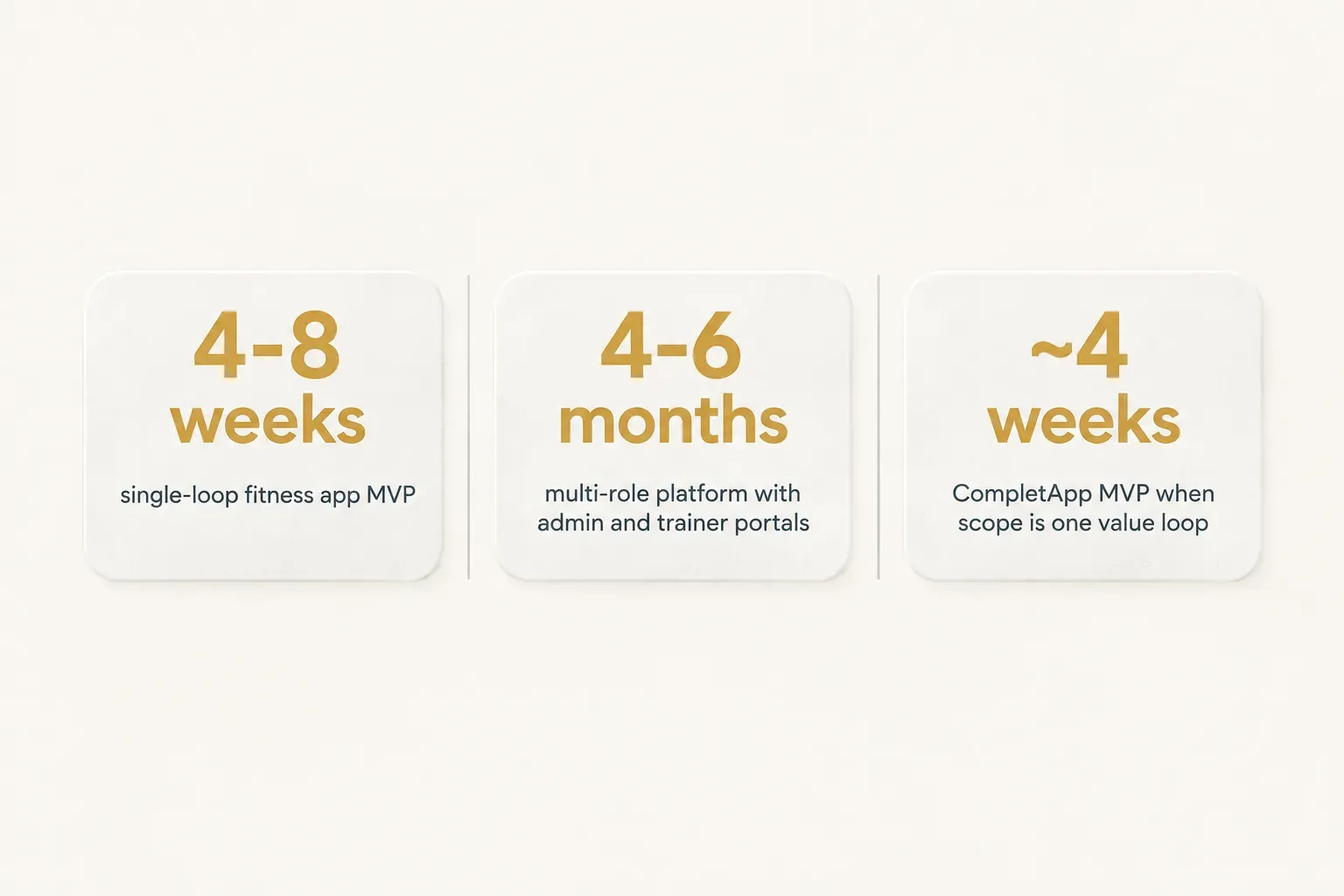
A focused MVP built around one core value loop can ship in 4 to 8 weeks. That means one user role, one primary action, and one clear reason to open the app tomorrow.
CompletApp works on this model, shipping a functional MVP in roughly four weeks when the scope holds to a single value loop.
A multi-role platform is a different animal.
Admin portal, trainer portal, and client app, with billing and integrations, realistically runs 4 to 6 months before a confident public launch.
The gap isn’t developer speed.
It’s the number of permission states, role combinations, and edge cases that have to be designed, built, and tested. Three roles don’t triple the work.
They roughly square it.
A Framework for Prioritizing Features
Sort every proposed feature into one of three layers.
The core value loop is the minimum sequence that delivers value: open app, start workout, log it, see progress. If removing a feature breaks that sequence, it ships in v1.
The retention layer makes people come back.
Streaks, push notifications, plan adaptation, weekly summaries. Valuable, but pointless if the loop itself doesn’t work.
This is v1.1 through v1.3 territory.
The expansion layer covers social feeds, marketplaces, advanced AI coaching, and community challenges.
Each one is a product bet, not a feature.
Build them once you have data proving where users actually engage.
Score every feature with one question: does removing this break the core loop?
If no, it waits.
The most common and most expensive mistake is building analytics dashboards, gamification systems, and AI chat before proving that basic workout tracking retains users past week two. Teams do it because those features are fun to demo.
Then week-4 retention comes back at 8% and the gamification was decorating a leak.
Technical Decisions That Shape the Product
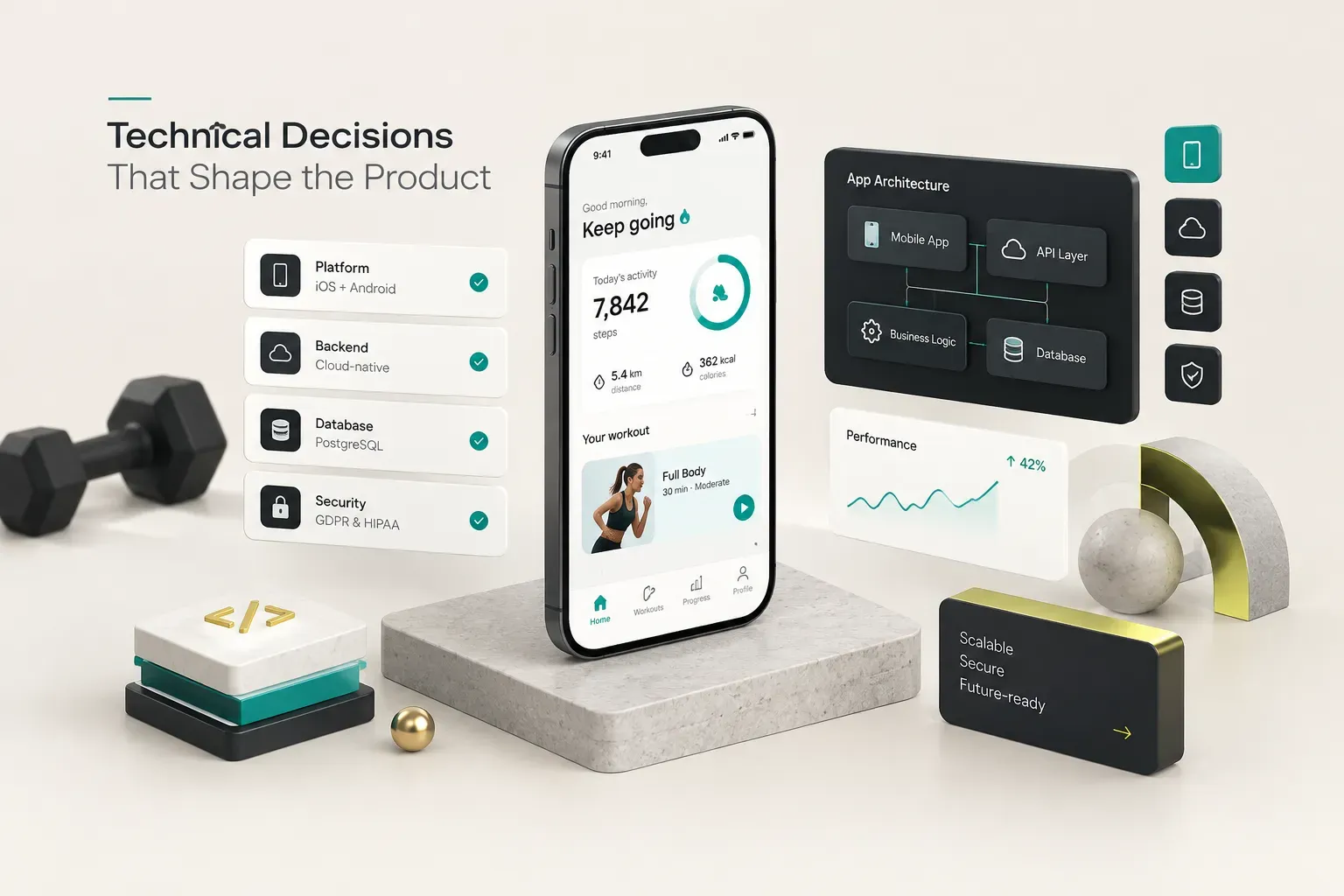
Three technical choices will constrain everything you do for the next two years. Get them right early, because reversing them later costs more than the original build.
Native or Cross-Platform
Native iOS and Android development gives you the deepest sensor access, the smoothest edge-case animation, and first-day support for new OS APIs. For apps doing continuous heavy camera work, like real-time rep counting through pose estimation, that margin can matter.
The cost is structural.
Two codebases, two teams, two release cycles, two sets of bugs. Every feature gets specified once and built twice, and they drift apart within six months.
Cross-platform app development with Flutter or React Native has closed most of that gap. Flutter handles HealthKit and Health Connect access, camera pipelines, background sync, and 60fps animation at near-native quality for the overwhelming majority of fitness use cases, from one codebase shipping to both stores.
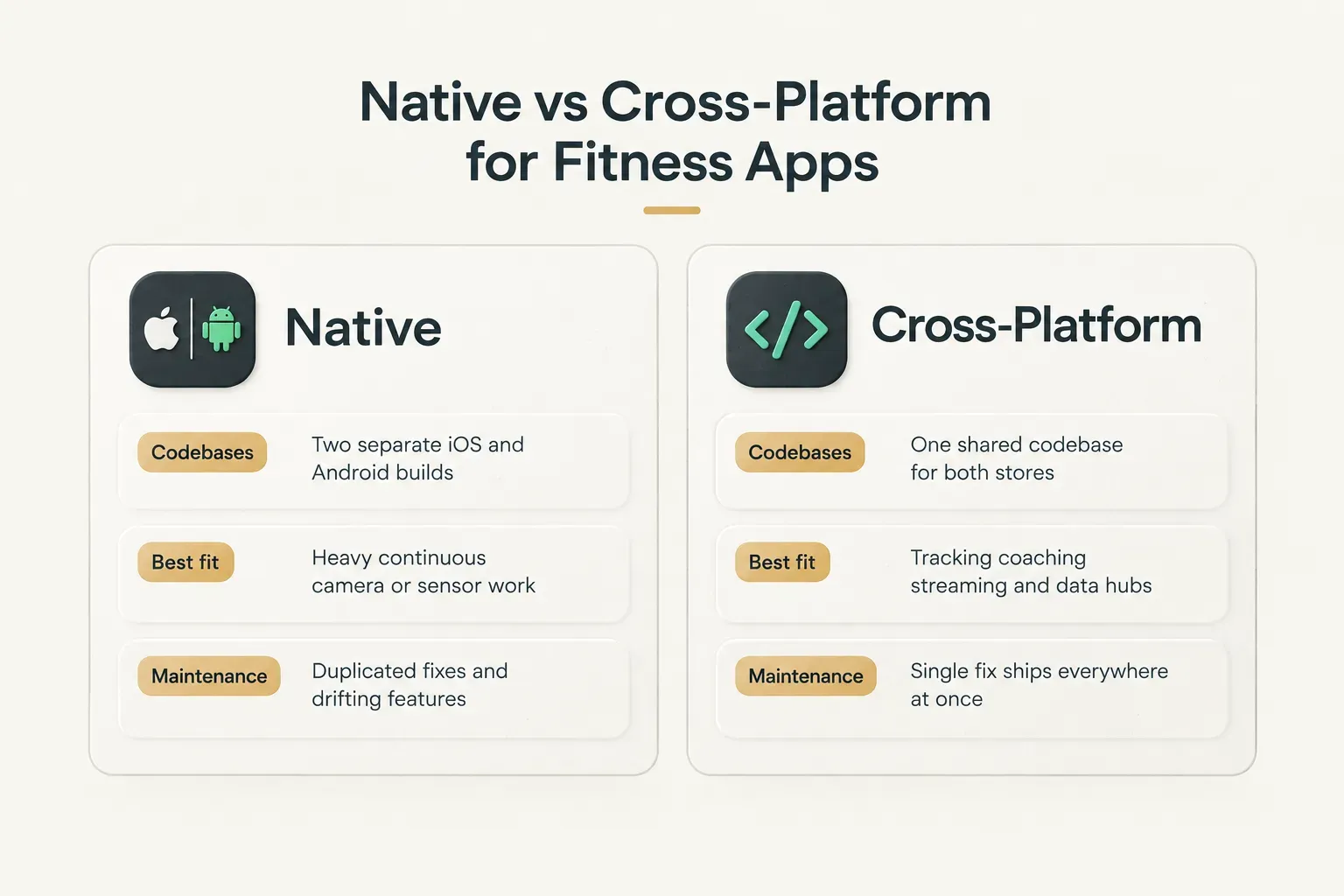
Choose native when your differentiator is the sensor processing. Choose cross-platform for almost everything else, especially when speed to validation matters more than a 3% animation improvement nobody will notice.
Wearable and Health-Data Integrations
Here’s what surprises teams: integrating five wearables is not five times harder than integrating one.
It’s more like fifteen, because the platforms disagree with each other.
Apple HealthKit requires per-data-type consent, and it deliberately hides whether a user denied read access, so your app cannot tell “no data” from “no permission.” You have to design UI that handles both gracefully.
Google Health Connect replaced Google Fit APIs and uses its own permission model with separate read and write grants per record type, plus its own history-access rules. It’s an on-device datastore, which changes your sync assumptions entirely.
Garmin, Fitbit, Oura, and Whoop each use OAuth with distinct token lifetimes, webhook behaviors, and rate limits. Exceed a rate limit during a bulk historical backfill and you’ll get throttled for the whole user base, not just one account.
Then the measurements disagree.
Resting heart rate is calculated differently on every device. Sleep stages are proprietary and non-comparable across vendors.
A user switching from Fitbit to Oura will see their “deep sleep” change by 40 minutes overnight and blame your app.
Background sync adds another layer.
iOS throttles background execution aggressively based on user behavior patterns, and Android’s Doze mode restricts network access on idle devices.
Neither guarantees a sync window.
The fix is honesty in the UI.
Show a clear last synced timestamp, let users pull to refresh, and never render a number without indicating its freshness.
Stale data presented as current is the fastest way to lose trust in a health app.
Where AI Should Drive Recommendations
AI earns its place in fitness apps in a narrow band: adaptive coaching that adjusts progression based on logged performance, and coaching summaries that explain what changed and why.
Both require clean structured data.
Sets, reps, loads, RPE, completion rates, and recovery signals.
Feed a model unstructured free-text logs and you get confident nonsense.
Four guardrails are non-negotiable.
Flag contraindications so the system never escalates load for a user reporting joint pain. Route medical-adjacent content through human review.
Make the reasoning visible, so a user sees “reduced volume 10% because you missed two sessions” instead of a silent change.
And keep personalized workout plans deterministic where safety matters, using AI to adjust parameters rather than invent exercises.
If a user can’t tell why the plan changed, they’ll assume it’s broken. Visible reasoning is a retention feature, not a compliance checkbox.
Compliance, Ownership, and Launch Readiness
Most fitness founders worry about the wrong regulation, then sign a contract that quietly hands their app-store account to an agency. Both problems are avoidable in an afternoon.
HIPAA and FTC Obligations
HIPAA applicability depends on your business relationship, not on whether your app touches health data. HIPAA covers covered entities (providers, health plans, clearinghouses) and their business associates.
If your app serves a clinic, hospital, employer health plan, or physical therapy practice and handles protected health information on their behalf, you’re a business associate. You need a BAA, access controls, audit logging, encryption in transit and at rest, and breach procedures.
A direct-to-consumer fitness app where users log their own workouts is not covered by HIPAA by default. Selling B2C subscriptions for a strength training app does not make you a HIPAA entity.
That is not a free pass.
The FTC Health Breach Notification Rule applies to consumer health apps that collect identifiable health information and are not HIPAA-covered. It requires notifying users, the FTC, and sometimes the media after unauthorized disclosure, and the FTC has clarified that sharing data with advertisers without consent can itself count as a breach.
Layer on Apple and Google store policies, which forbid using health data for advertising, plus GDPR if you have EU users. Practical takeaway: build proper consent management, honest privacy disclosures, and real health data privacy controls regardless of which framework applies.
Who Owns the Code and Data
Confirm every item on this list in writing before you sign anything.
- Source code repository. Owned by your organization, with your account as admin, from day one. Not transferred “at final payment.”
- App Store and Google Play developer accounts. Registered to your company entity. This is the single most common lock-in trap, because losing the account means losing your reviews, ranking, and subscribers.
- Cloud and hosting accounts. Your AWS, GCP, or Firebase project, billed to you, with the agency added as a collaborator.
- Third-party API credentials. Stripe, RevenueCat, Garmin, Fitbit, and analytics keys registered under your accounts.
- Analytics dashboards. Your historical event data, exportable, not living in an agency workspace.
- Design files and documentation. Source design files, architecture notes, and API documentation handed over as deliverables.
Watch for three lock-in patterns: agency-held developer accounts, undocumented proprietary frameworks, and code delivered only as compiled builds. Any of them makes switching vendors expensive by design.
Launch Readiness and Post-Launch Metrics
Store submission is an administrative step.
Launch readiness is six things.
Beta testing through TestFlight and Play Internal Testing with real users on real devices.
Crash monitoring wired up before launch, not after the first bad review.
Analytics and event tracking instrumented against your actual funnel.
Consent flows tested for both accept and decline paths.
A documented support process with a response SLA.
And a rollback plan, including remote feature flags so you can disable a broken feature without waiting on app review.
Then measure the things that predict survival.
| Metric | What It Measures | Healthy Benchmark |
|---|---|---|
| Activation rate | New users completing first meaningful action | 40-60% of installs |
| Workout completion rate | Started sessions finished and logged | Above 70% |
| Week-4 retention | Users still active 28 days after install | 15-25% for consumer fitness |
| Subscription conversion | Free users converting to paid | 2-5% overall, 30%+ from trials |
| Wearable sync success rate | Sync attempts completing without error | Above 95% |
| Crash-free sessions | Sessions ending without a crash | 99.5% or better |
| Notification opt-out rate | Users disabling push after onboarding | Below 20% |
Those benchmarks are directional, not universal. What matters is tracking them from week one so you can see whether changes help.
Maintenance is a permanent line item, not a project.
Annual iOS and Android releases break things every autumn. Dependencies need security patching. Wearable APIs deprecate endpoints with a few months’ notice.
Budget 15-20% of the original build cost annually, and reserve capacity for iteration based on what your fitness app retention data actually shows.
Deciding Your Next Step
The right partner depends on which product you’re actually building.
Building a single-loop consumer app? Prioritize a cross-platform studio that can validate fast, ship in weeks, and iterate on real retention data.
Speed to learning beats architectural perfection when you don’t yet know if people want the thing.
Building a clinic-, gym-, or employer-integrated product that touches PHI? Compliance expertise comes first.
A studio that has never written a BAA or designed audit logging will cost you more in remediation than it saved in day rate.
One concrete action before you compare a single price: request a written proposal that lists scope assumptions line by line, states ownership terms for code and developer accounts, and names the integration limits explicitly.
Vendors who resist that request are telling you something useful. The ones who welcome it are the ones worth talking to twice.