Why Healthcare Apps Aren’t Just Apps
A consumer app that leaks an email address creates an awkward apology. A health app that leaks a diagnosis creates a federal reporting obligation, a class action risk, and a hospital partner who stops returning your calls.
That is the real difference.
Healthcare app development means building software that touches patient data, clinical workflows, or medical decisions, and every one of those three things carries rules that generic consumer product work never encounters.
The category your product falls into decides almost everything technical about it. A wellness tracker, a telehealth platform, and a diagnostic aid are three completely different engineering problems even if they look similar in a wireframe.
Category determines your architecture, your compliance path, which integrations are even possible, and how you test.
Classification comes before features. Founders who reverse that order usually pay for the mistake twice: once in rework, once in delay.
This guide walks the full path.
First, working out what kind of app you are actually building.
Then the compliance question, including the parts that surprise people, like direct-to-consumer apps that fall outside HIPAA but still owe breach notifications.
After that, data architecture: HL7 FHIR, electronic health records, consent, and the privacy risks hiding in your analytics stack.
Finally, the practical build: scoping an MVP, choosing native or cross-platform, clinical-specific testing, and what happens after launch when an EHR vendor changes an API without asking you first.
CompletApp approaches these builds compliance-first. Data flows, roles, and access controls get designed during discovery, not retrofitted after a security review flags them three weeks before launch.
Know What Kind of App You’re Building
Ask ten founders what their health app does and nine will describe features.
The regulators care about something else entirely: intended use. What are you claiming this software does for the person using it?
Wellness Apps and Patient Portals
Step counters, sleep trackers, hydration reminders, and medication nudges usually sit in the lowest-risk tier. So do many appointment-scheduling portals that simply book a slot and send a confirmation.
Lower risk is not zero risk.
If your app collects identifiable health information directly from consumers and you are not operating under a covered entity relationship, the FTC Health Breach Notification Rule still applies. That rule has real teeth, and the FTC has enforced it against period trackers and telehealth marketers with multimillion-dollar settlements.
The practical reading: no HIPAA obligation does not mean no obligation.
Telehealth and Clinical Decision Support
Telehealth platforms, e-prescribing tools, secure messaging, and video visit apps almost always land inside HIPAA. Not because video is inherently regulated, but because these products operate on behalf of providers or health systems under a signed business associate agreement.
Once a BAA exists, the HIPAA Privacy Rule and HIPAA Security Rule both bind you directly. You inherit obligations around minimum-necessary access, breach reporting timelines, and documented safeguards.
Clinical decision support is the grey zone.
Under the 21st Century Cures Act, software that suggests rather than dictates can stay outside FDA oversight, but only if the clinician can independently review the basis for the recommendation.
Show your inputs, your logic, and your sources, and you likely stay exempt. Output a score with no explanation and you have probably built a regulated device.
Regulated Medical Device Software
Software as a medical device means the software itself performs a medical function: diagnosing, treating, preventing, or mitigating disease. Think an app that reads a skin lesion photo and returns a melanoma likelihood, or one that titrates insulin doses.
FDA guidance on FDA mobile medical applications draws the line at claims and risk, not at technology.
An algorithm is not regulated because it uses machine learning.
It is regulated because of what you say it does.
Here is how a single feature moves an app across that line.
A symptom tracker that logs headaches and lets users export a PDF for their doctor is a wellness tool.
Add an AI triage score that tells the user “your symptoms suggest a possible stroke, seek emergency care,” and you have made a diagnostic claim with a time-critical safety consequence.
Same database. Same UI. Completely different regulatory pathway, validation burden, and liability profile.
That is why classification happens before the product roadmap, not after.
Compliance Isn’t a Feature You Add Later
The most common misconception in this industry: “we handle health data, so HIPAA applies to us.”
That sentence is wrong often enough to be dangerous.
HIPAA or the FTC Rule?
HIPAA applies based on relationship, not data type.
The law covers health plans, healthcare clearinghouses, and providers who transmit health information electronically, plus the business associates who handle protected health information on their behalf under a signed BAA.
If a hospital contracts you to build its patient app, you are a business associate.
HIPAA applies.
If you sell a fitness app directly to consumers with no provider relationship, HIPAA generally does not apply to you at all, even though you hold heart rate data, weight logs, and mental health journals.
What fills that gap is the FTC Health Breach Notification Rule, expanded in recent years to explicitly cover health apps and connected devices. It requires you to notify affected users, the FTC, and in larger breaches the media.
Notably, the FTC has treated unauthorized disclosure to advertising partners as a reportable breach, not just hacking incidents.
Add state law on top.
Washington’s My Health My Data Act, Nevada’s equivalent, and the health data provisions inside California and Colorado privacy law reach consumer apps that HIPAA never touches.
When the FDA Gets Involved
Work through four questions in order, and be honest about the answers.
- What is your intended use statement? Write it in one sentence, the way you would say it on your website. Marketing copy is evidence of intended use.
- Do you make a diagnostic or treatment claim? “Detects,” “diagnoses,” “recommends a dose,” and “predicts risk of” are claim words. “Logs,” “tracks,” and “reminds” generally are not.
- Does a clinician sit between the output and the patient? Clinician-facing tools have a wider exemption path than patient-facing ones.
- Can the user independently review the basis for your recommendation? This is the core Cures Act clinical decision support criterion. Opaque outputs fail it.
Get a regulatory read before you build, not after.
A pre-submission conversation with the FDA costs weeks. Rebuilding a validated product costs quarters.
Compliance vs Security: Not the Same
An app can be fully HIPAA compliant on paper and trivially hackable in production. These are two different disciplines with two different deliverables.
Compliance is administrative: signed BAAs with every subprocessor, a documented risk assessment, written policies, workforce training records, incident response procedures, and sanctions policies.
Auditors read documents.
Security engineering is technical: data encryption at rest and in transit, role-based access control, session management, audit logging of every PHI access event, secrets management, dependency scanning, and penetration testing against the actual build.
The gap shows up in predictable places.
Mobile apps that cache PHI in unencrypted local storage. APIs that check authentication but never authorization, so any logged-in user can request any patient ID. Audit logs that record writes but not reads, making it impossible to prove who viewed a record.
None of those failures would show up in a policy review.
All of them would show up in a breach.
Building Data Flows That Hold Up
Every healthcare app eventually needs data it did not create. That is where architecture gets interesting, and where timelines quietly double.
FHIR, HL7 and EHR Connections
HL7 FHIR is the modern standard for exchanging health data, and it works the way web developers expect: resources exposed over REST APIs, returned as JSON. Core resources include Patient for demographics, Observation for vitals and lab results, MedicationRequest for prescriptions, and Condition for diagnoses.
SMART on FHIR layers OAuth 2.0 authorization on top, giving you scoped tokens, patient context, and a launch flow that works from inside the EHR or standalone. It is the closest thing healthcare has to a sane developer experience.
Then you meet reality.
Plenty of hospital systems still run HL7v2, a pipe-delimited message format from the 1980s delivered over MLLP, often through an interface engine like Mirth or Rhapsody. Lab results and ADT (admit, discharge, transfer) feeds in particular remain HL7v2 in many facilities.
The bigger constraint is write-back.
Epic, Oracle Health, and comparable vendors generally restrict which applications can write data into the chart, and approval involves vendor programs, hospital IT governance, and sometimes a security questionnaire that runs to several hundred questions.
Assume your first integration is read-only.
Plan two-way sync as a phase two with its own timeline.
Consent, Roles and Access Rules
Patient consent management is not a checkbox on a signup screen.
It is a data-flow design problem that shapes your schema.
Consider what the system has to handle: a patient authorizing data sharing with one specialist but not another, a caregiver with proxy access to an elderly parent’s records, a revocation that must stop future access without deleting historical audit trails, and minimum-necessary rules that limit what a scheduling clerk sees versus a treating physician.
Then add time.
Permissions change. A pediatric patient turns 18 and parental proxy access must terminate automatically, with a clean handover.
Custody arrangements change. A staff member moves departments.
If consent is a boolean column, all of this becomes a manual support ticket.
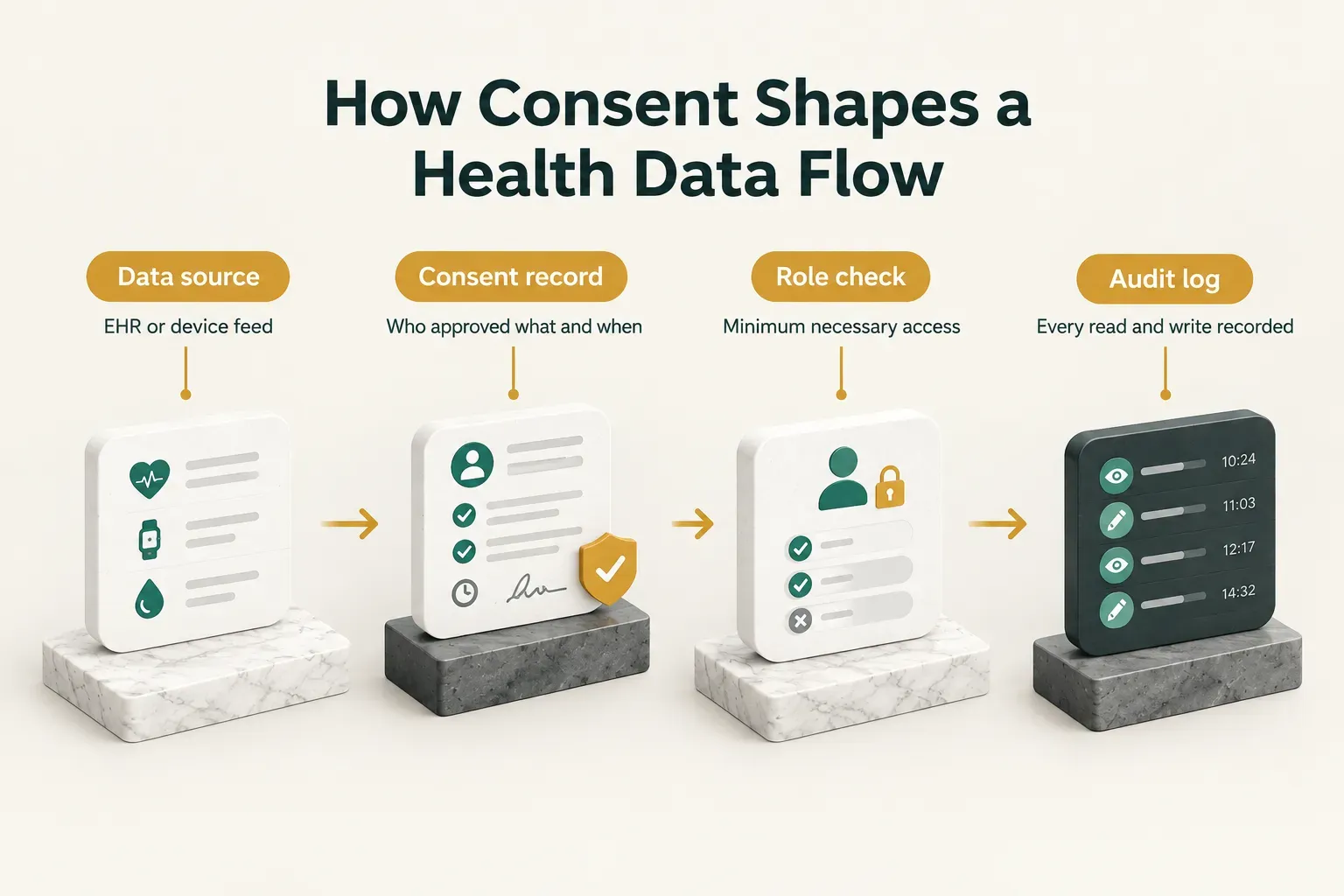
Model consent as its own versioned entity with a scope, a grantor, a grantee, a start date, and an end condition. Then enforce it at the API layer, never in the UI alone.
The Privacy Risk Hiding in SDKs
The largest health data enforcement actions of recent years did not involve hackers.
They involved tracking pixels.
Analytics SDKs, crash reporting tools, advertising networks, session replay software, and attribution platforms all send data off your servers to companies that have never signed a BAA with you. And health data leaks through them in ways that are easy to miss.
- Screen names and URL paths. An analytics event for screen: oncology_appointment_booking reveals a diagnosis, even with no patient name attached.
- Push notification payloads. “Your HIV test result is ready” renders on a lock screen and passes through a third-party push service.
- Crash reports. Stack traces routinely capture in-memory variables, request bodies, and user identifiers.
- Session replay. Recording the screen captures everything the patient typed, including free-text symptom descriptions.
- Third-party AI services. Sending clinical notes to a general-purpose model API without a BAA and zero-retention terms is a disclosure of PHI.
Audit every SDK in your build before launch. For each one, answer two questions: what does it transmit, and is there a signed BAA covering it?
If either answer is unclear, it does not ship.
Turning a Brief Into a Live App
Most healthcare projects do not fail on code quality.
They fail because the scope was defined as a feature list instead of a clinical outcome.
Scoping the MVP and Brief
- Name the single clinical or operational outcome. Write one sentence: “Reduce no-show rates for post-discharge follow-ups” or “Let nurses log wound assessments at the bedside.” If you cannot state it in a sentence, the scope is not ready.
- Separate the core from the optional layers. AI, wearable integrations, video visits, payments, and multi-EHR support are all layers that sit on top of a core workflow. Each one roughly adds its own compliance surface, vendor contract, and test matrix.
- Document every user role explicitly. Patient, caregiver, nurse, physician, scheduler, and admin each need defined permissions. Role definitions drive your role-based access control model and half your test cases.
- Write the intended use statement. This one paragraph determines your regulatory path, so it belongs in the brief, not in the marketing plan.
- Map the data flows end to end. For each data element: where it originates, where it is stored, who can read it, where it is transmitted, and how long it is retained.
- State the compliance scope in writing. HIPAA business associate, FTC rule only, FDA-exempt clinical decision support, or regulated device. Ambiguity here is the single most expensive thing in the brief.
Native Code or Cross-Platform?
The honest answer is that this decision matters less than founders think, and matters enormously in a small number of specific cases.
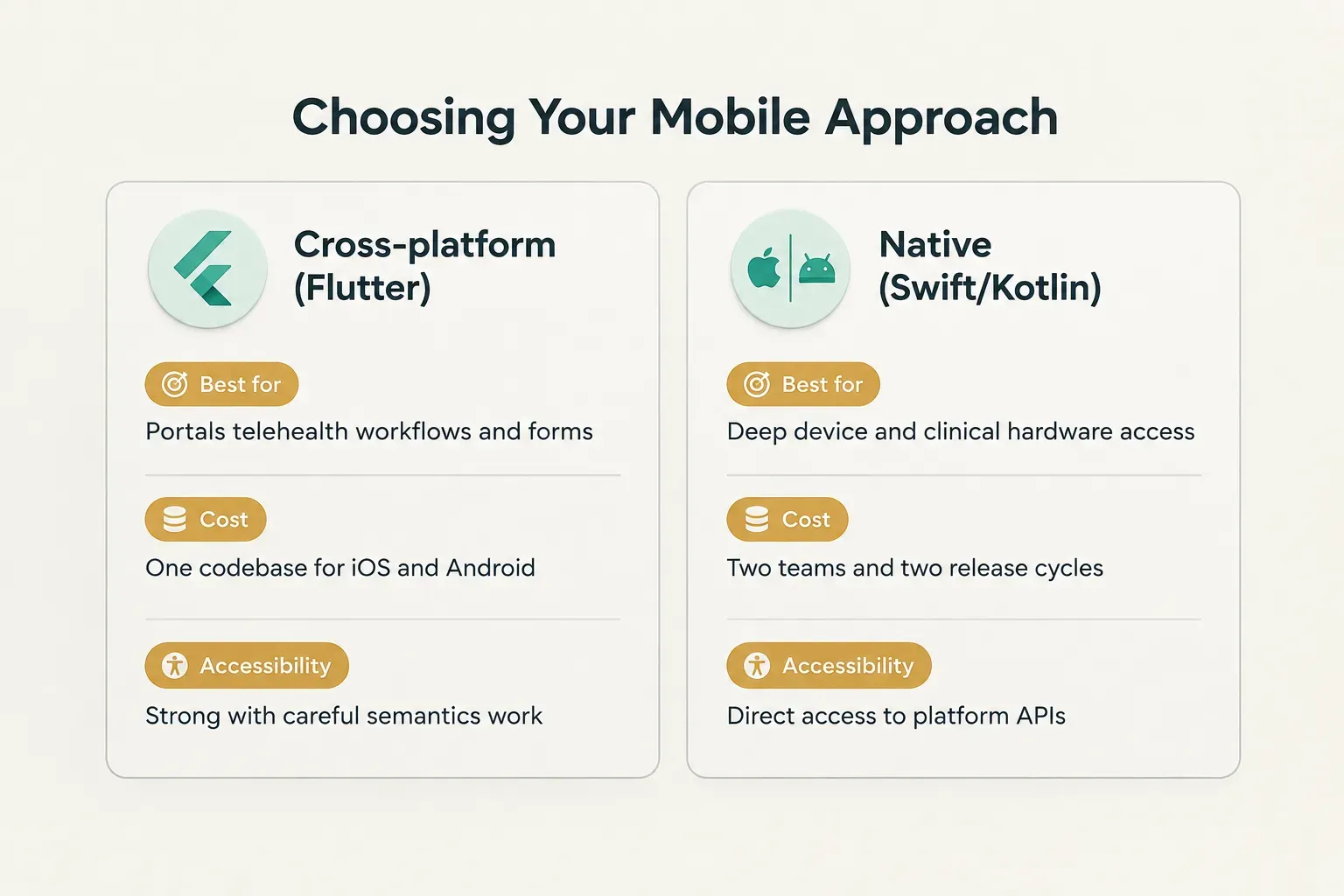
- Check your device integrations first. Bluetooth medical devices, NFC readers, continuous glucose monitors, and proprietary clinical hardware SDKs often ship native-only. If your product depends on one, that constraint decides the stack.
- Test offline behaviour early. Home health and inpatient settings have dead zones. Your app needs a local queue, conflict resolution, and a clear sync state indicator, regardless of framework.
- Validate accessibility APIs against real assistive tech. VoiceOver and TalkBack behave differently across frameworks. Test with actual screen readers, not automated scanners.
- Price the maintenance, not just the build. Two native codebases means two sets of OS upgrade fixes every autumn. A single Flutter codebase, which is CompletApp’s default approach, typically covers iOS and Android efficiently unless deep hardware access forces the issue.
Testing, Launch and Upkeep
Standard QA catches broken buttons.
Clinical QA catches the bugs that hurt people.
- Test abnormal and impossible values. A blood pressure of 400/300, a negative weight, a birth date in the future. The system must reject or flag them, never silently store and display them as fact.
- Tune alert thresholds against fatigue. If clinicians dismiss 95% of your alerts without reading them, you have built a hazard. Measure dismissal rates during pilot, not after rollout.
- Break the network deliberately. Kill connectivity mid-submission. Force a sync conflict. Confirm nothing is lost and nothing is duplicated.
- Hunt duplicate patient records. Two records for the same person is one of the most common and most dangerous data problems in health IT. Test your matching logic with near-identical demographics.
- Check units and timezones obsessively. Milligrams versus micrograms. Celsius versus Fahrenheit. A medication logged at 11pm local that records as the next day in UTC. These bugs are quiet and consequential.
- Run accessibility regression every release. Screen reader flow, contrast, tap target size, and plain-language copy for low digital literacy users. Regressions creep in constantly.
- Stand up breach response before launch day. Detection, containment, notification timelines, and named owners. Write it while you are calm.
- Budget for ongoing upkeep. Security patching, dependency updates, annual OS releases, EHR API version changes, and clinical content reviews. Plan on meaningful recurring spend, not a one-off build cost.
Before signing with a development partner, get clear answers on five things: who owns the code and repositories, whether they will sign a BAA and name their subprocessors, who responds to a production incident at 2am, how security testing is handled and by whom, and what the handover looks like if you part ways.
Your Next Move Before You Build
Classification is the cheapest work you will ever do on a health product.
Getting it wrong is the most expensive.
Founders who define their category before writing a brief avoid the pattern that kills timelines: building for four months, discovering during a hospital security review that the architecture cannot support the required access controls, and rebuilding the data layer from scratch.
Use a simple decision rule.
If your app handles protected health information for or on behalf of a covered entity, start with HIPAA, BAAs, and a security architecture designed around minimum-necessary access.
If it makes any diagnostic or treatment claim, get an FDA read before you build anything.
If neither applies, focus on security engineering and the FTC Health Breach Notification Rule, plus applicable state health privacy laws.
Then take one concrete step.
Write your intended use statement in a single paragraph, map your core workflow end to end, and list every user role with its permissions.
Bring that document to a technical partner and ask for a scoping conversation, not a quote against a feature list. The difference in what you get back is substantial.