
The Marketplace Problem Founders Underestimate
Marketplace app development means building a two- or multi-sided platform where independent buyers and sellers transact with each other.
You do not own the inventory.
You own the rules, the trust, and the transaction.
That distinction sounds academic until it hits your codebase.
A storefront app sells one company’s products at one company’s prices.
A marketplace app has to handle hundreds of independent sellers who set their own availability, change their minds, cancel bookings, and occasionally try to take the transaction off-platform entirely.
Here is the argument this guide makes: your platform business model, your liquidity strategy, your trust-and-safety rules, and your payment state transitions have to be designed together, before a single sprint starts.
Layer them on afterward and you end up rebuilding the order system twice.
The most common failure pattern is treating the buyer app, the seller app, and the admin tools as one build.
They are not.
They are three separate workflows with different goals, different permissions, and different definitions of success.
Buyers want speed.
Sellers want predictable payouts and control.
Admins want evidence and override power.
Most marketplaces do not fail because the code broke. They fail because nobody decided what happens when a seller cancels after payment is authorized but before fulfillment.
What follows covers architecture, marketplace MVP scope, payment flows, tech stack decisions, realistic cost and timeline ranges, and the post-launch metrics that generic app analytics completely miss.
Treat it as one connected system, because that is how it behaves in production.
Marketplace Anatomy and the Transaction Engine
Marketplace Apps vs Ecommerce Apps
An ecommerce app has one catalog, one pricing authority, and fixed margins.
You know your inventory count.
You control the product photos.
You decide the refund policy and you eat the cost when you break it.
A marketplace has none of that.
Every seller sets their own price and availability, every listing is user-generated content that might be inaccurate or fraudulent, and the platform earns a take rate on completed transactions rather than a margin on goods.
This changes the architecture in ways founders consistently underestimate.
Your listing schema needs to support variable, seller-defined attributes. Your search has to rank across quality signals you did not create. Your payment layer has to split a single buyer charge across two or more recipients.
And your database needs to track who is responsible for what at every point in the flow.
The practical test: in ecommerce, “out of stock” is a data problem.
In a marketplace, it is a trust problem, a refund problem, and a seller-reputation problem all at once.
The Transaction State Machine
Four distinct workflows need separate UX and separate permissions, and they rarely share screens:
- Buyer discovery and checkout. Search, filtering, search and matching algorithm results, listing detail, availability check, booking or cart, payment, and order tracking.
- Seller listing and payout dashboard. Listing management, calendar or inventory control, order acceptance, messaging, earnings breakdown, and payout history with fee transparency.
- Admin approval and moderation console. Seller onboarding review, listing approval queues, dispute resolution, manual refunds, payout holds, and user suspension, all behind role-based access control.
- The trust-and-safety layer. Cross-cutting rather than a screen: verification status, reputation and review systems, content moderation, fraud scoring, and reporting flows that every other workflow reads from.
Underneath all four sits the booking and order state machine.
Write it down explicitly before anything else, because every feature you build later either reads from it or mutates it.
The happy path runs: listing created, availability checked and held, order or booking placed, payment authorized, fulfillment in progress, transaction completed, payout released.
Seven states.
Each one has a timestamp, an actor, and a reversible or irreversible flag.
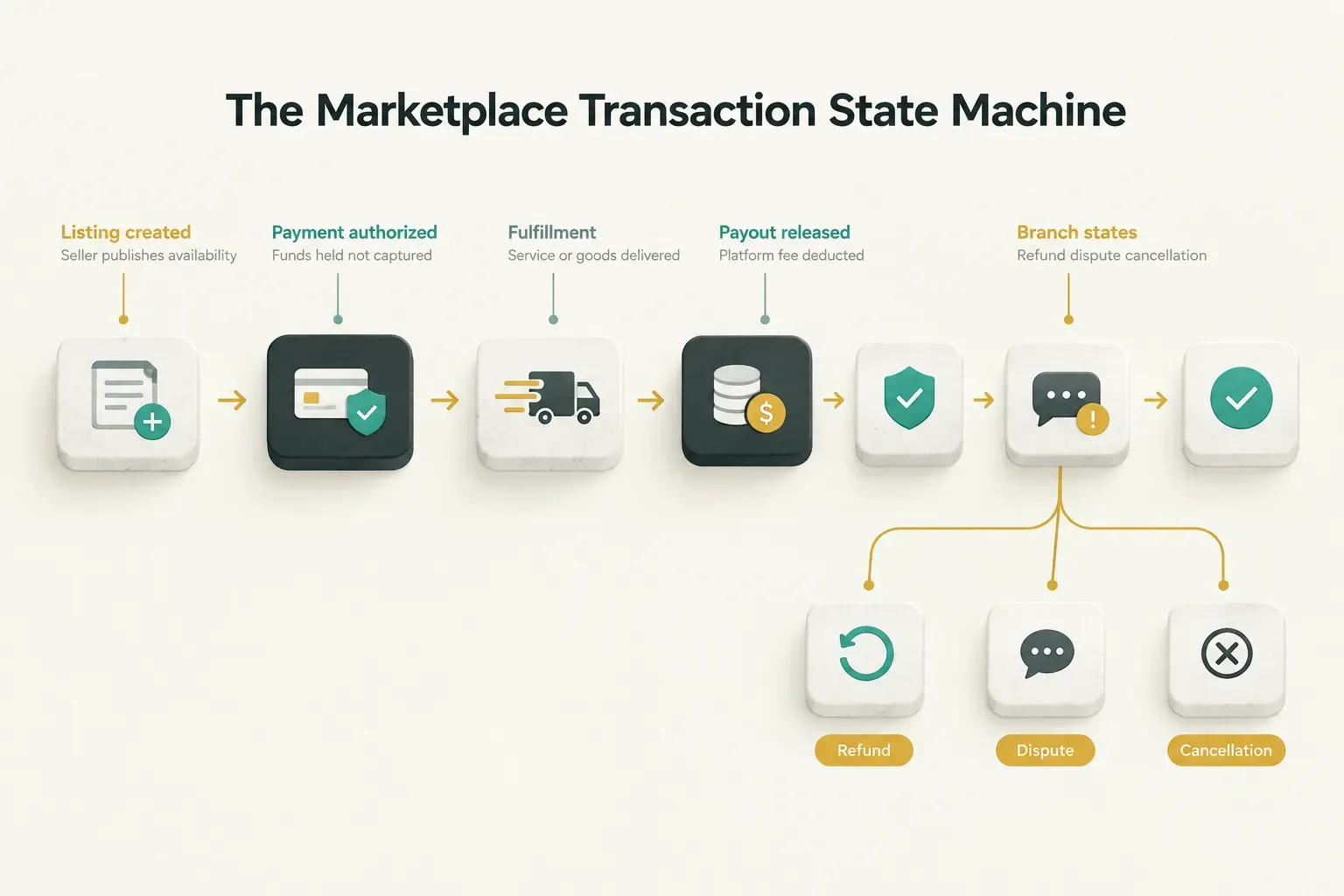
Then come the branches, and this is where teams lose months.
Refund (full or partial, before or after capture).
Dispute (buyer claims non-delivery, seller claims buyer no-show).
Cancellation (by either party, at different points, with different penalty rules).
Each branch has commission consequences.
Does the platform keep its fee on a cancelled booking? Does a partial refund reduce the take proportionally?
Answer these in a spreadsheet before you answer them in code.
Solving the Chicken-and-Egg Problem
Buyers will not show up without supply.
Sellers will not list without demand.
That is the chicken-and-egg problem, and it has killed more marketplaces than any technical failure.
The fix is not clever growth hacking.
It is narrowness.
Launch in one city, one category, or one supply segment tight enough that a buyer searching almost always finds a match.
Supply and demand liquidity in a small pond beats thin coverage across a continent, every time.
Airbnb started with air mattresses in San Francisco during conferences.
Uber started with black cars in one city.
Network effects only compound after local density exists, not before.
One more architectural point that gets deferred and should not: trust and safety belongs in the MVP.
Not version two.
The first fraudulent listing, fake review, or off-platform payment attempt will arrive within weeks of launch, and retrofitting moderation into a live system means touching every table you already shipped.
How Money and Safety Actually Flow
Split Payments and Payout Timing
In a marketplace, one buyer charge becomes at least two money movements.
The buyer is charged the full amount, the platform fee is deducted, and the remainder routes to the seller’s connected account.
Modern payment providers handle the plumbing through split payments and connected seller accounts, but you still decide the policy.
And the policy is a business decision disguised as a technical one.
Payout timing is the lever.
Instant payouts make sellers love you and expose the platform to fraud, because money leaves before the service is confirmed.
Scheduled payouts (weekly, or 48 hours after completion) balance risk.
Held payouts, released only after a dispute window closes, behave like escrow and protect buyers most.
Each choice moves your cash position.
Held funds sit on your balance sheet and can look like revenue to a founder who has not separated platform earnings from seller liabilities.
They are not your money.
Track them separately from day one.
Three marketplace-specific realities do not exist in single-merchant ecommerce:
- Negative seller balances. A refund issued after a payout leaves the seller owing the platform. Your data model needs to support a negative balance and a recovery path, not just crash.
- Chargeback liability. When a buyer disputes with their card issuer, the platform is usually the merchant of record and eats the loss plus the fee. Budget for it as a real line item, not an edge case.
- Tax reporting obligations. Depending on jurisdiction, platforms must collect seller tax details and report earnings above thresholds. Collecting that data at onboarding is trivial. Chasing 400 sellers for it in January is not.
Verification and Fraud Prevention
Tie KYC and identity verification to payout release, not to signup.
This is the single highest-leverage fraud control in marketplace app development.
Let sellers browse, draft listings, and explore the product with a light account.
Require verified identity, bank details, and business documents before the first payout clears.
Friction placed at the money moment filters bad actors without strangling onboarding.
Layer the rest:
- Listing moderation using automated pre-screening (prohibited keywords, image classification, duplicate detection) with human review for flagged items and all first listings from a new seller.
- Fake review detection based on transaction-linked reviews only. If a review cannot be tied to a completed order ID, it does not publish. That one rule removes most review fraud.
- Anomaly flags on unusual transaction patterns: a new seller with sudden high-value orders, repeated same-card purchases across accounts, or a spike in cancellations followed by payout requests.
Fraud controls should generate a queue, not a block.
Automatic suspension of legitimate sellers costs you supply, which is harder to replace than demand.
Disputes, Refunds, and Chargebacks
These three get lumped together in most requirement documents.
They are separate flows with separate consequences, and conflating them produces accounting chaos.
A refund is agreed.
Buyer and seller (or platform policy) accept the reversal.
The question is only whether the platform fee reverses too, and whether it happens before or after capture.
A cancellation happens before fulfillment.
Policy decides the penalty split: does a late seller cancellation cost them a fee, and does the buyer get a full refund plus a credit?
A dispute is contested.
Someone has to adjudicate, and that someone is your admin team.
Which means your admin dashboard needs an evidence trail: message history between parties, timestamped state transitions, photos or delivery confirmations, previous dispute counts for both users, and the exact payout status at the moment of the claim.
Without that trail, dispute resolution becomes a coin flip, and both sides lose trust in the platform.
Build the audit log before you build the dispute screen.
Choosing Your Tech and Build Strategy

Native, Cross-Platform, or Both
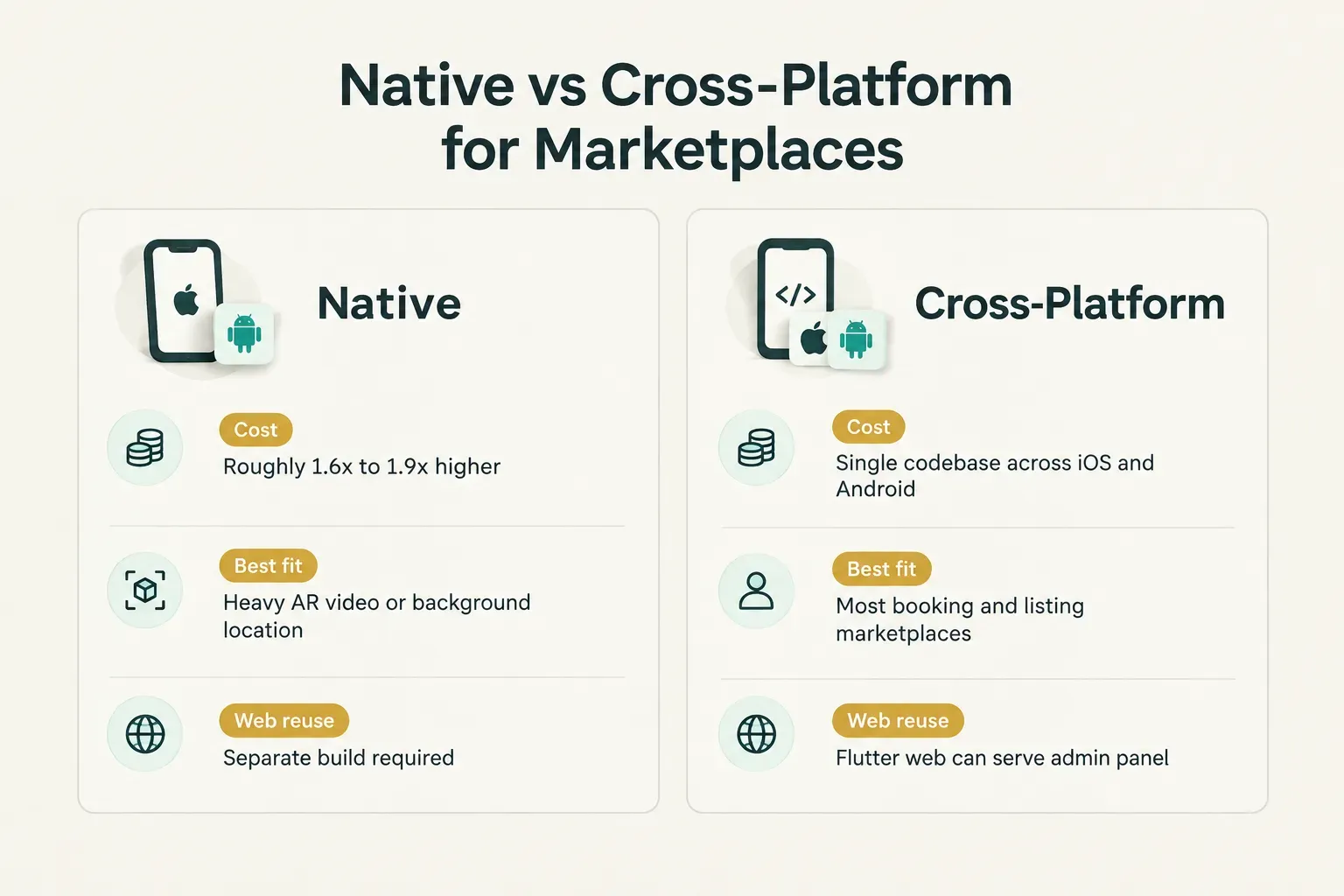
Native development gives you the best raw performance and the deepest platform integration.
It also means two codebases, two teams or two skill sets, and roughly 1.6 to 1.9 times the build cost of a single shared codebase.
For a marketplace, that trade usually lands in favor of cross-platform app development.
Flutter or React Native produces one codebase serving iOS and Android, and Flutter in particular can extend to the web build for your seller dashboard and admin console, which is where a huge chunk of marketplace UI actually lives.
CompletApp’s Frendex booking marketplace was shipped this way: a two-sided booking product with buyer discovery, provider availability, and a management panel, built cross-platform and delivered in weeks rather than quarters.
The GoalJournal app followed the same pattern, proving the point that a shared codebase collapses the gap between “we decided” and “it is in the store.”
Go native when your core value depends on it: heavy real-time video, complex AR, intensive background location tracking, or sub-50ms interaction budgets.
Otherwise, cross-platform buys you speed, and speed is what you need to reach liquidity before your runway ends.
Modular Monolith Before Microservices
Start with a modular monolith that has explicit domain boundaries.
Four modules cover most marketplaces: listings, orders, payments, and identity.
Each module owns its data and exposes a clear internal interface.
No module reaches into another’s tables directly.
That discipline costs you almost nothing at the start and gives you clean seams to split along later.
Premature microservices are a founder trap.
You get distributed transactions, network failures between services, five deployment pipelines, and an on-call rotation, all to serve 200 daily transactions.
Split a component out when team size or genuine traffic pressure justifies it, typically when more than three engineers are stepping on each other in the same domain.
On build-versus-buy, the rule is short: buy commodity infrastructure, build differentiation.
- Buy: payments and split payouts, identity verification, maps and geocoding, real-time messaging, push notifications, analytics, and error monitoring. These are solved problems with mature providers and compliance already handled.
- Build: your matching logic, search ranking, availability model, and pricing or commission rules. These encode how your marketplace actually creates value, and no vendor can build them for you.
Where AI Creates Real Value
Most AI features in marketplace apps are decoration.
A handful move real numbers.
Five that consistently earn their keep in 2026:
- Semantic search over listings. Buyers describe what they want in natural language, not your taxonomy. Embedding-based search raises match rate on long-tail queries where keyword search returns zero results.
- Automated listing enrichment. Generating titles, categories, and attribute tags from a seller’s photos and rough description reduces listing abandonment, which is a direct supply-side win.
- Fraud and moderation triage. AI ranks the queue so human reviewers see the riskiest 5% first. It does not replace the reviewer. It makes one reviewer do the work of four.
- Personalized recommendations. Ranking by predicted completion likelihood rather than raw relevance lifts fill rate because you surface supply that will actually accept the order.
- Support ticket triage. Auto-classification and drafted responses cut first-response time, which matters most during disputes when trust is already fragile.
Everything else, the chatbots that cannot access order state, the AI-generated marketing copy, the “smart” features nobody asked for, can wait.
Cost, Timeline, and Metrics That Matter
What Drives Cost and Timeline
There is no single price for marketplace app development, and anyone quoting one without asking about payment complexity is guessing.
Cost is driven by a handful of variables that compound.
| Cost Driver | Low-Complexity Version | High-Complexity Version | Timeline Impact |
|---|---|---|---|
| Marketplace type | Single-category product listings | Service booking with calendars and time zones | +2 to 4 weeks |
| Number of user roles | Buyer, seller, admin (3 roles) | Plus agency accounts, sub-sellers, moderators (5+ roles) | +2 to 3 weeks |
| Payment complexity | Single-currency split payout, scheduled | Multi-currency, escrow, partial refunds, deposits | +3 to 5 weeks |
| Platform scope | Mobile only (cross-platform) | Mobile + responsive web + seller dashboard + admin console | +3 to 6 weeks |
| Geolocation features | City-level filtering | Live tracking, radius search, route estimation | +2 to 4 weeks |
| Real-time chat | Off-the-shelf SDK, text only | Custom, with moderation, attachments, and off-platform detection | +2 to 3 weeks |
| Moderation tooling | Basic approve/reject queue | Automated scoring, appeals, audit trail, bulk actions | +2 to 4 weeks |
| Third-party integrations | Payments + maps + push | Plus KYC, accounting, CRM, shipping carriers, tax engines | +1 to 4 weeks |
A focused marketplace MVP with three roles, single-currency split payments, and one transaction type typically runs 8 to 16 weeks.
The spread within that range is almost entirely about payment complexity and role count.
One thing founders skip: the mobile app is often not the acquisition channel.
A responsive web app captures search traffic and lets buyers transact without an install.
The seller dashboard determines whether supply stays.
The admin console determines whether your ops team can function at all.
Budget for all three, not just the App Store build.
Metrics That Actually Matter
Downloads, DAU, and session length tell you almost nothing about a marketplace’s health.
A marketplace is a matching engine, and you measure matching.
| Metric | What It Measures | Healthy Signal | What a Bad Number Means |
|---|---|---|---|
| Liquidity | Share of listings or requests that transact within a set window | Rising month over month in your core segment | Supply and demand are not meeting; narrow the segment |
| Match rate | Searches that produce at least one viable result | Above 80% in your launch category | Catalog too thin or filters too restrictive |
| Time to first transaction | Days from signup to first completed order, per side | Under 7 days for buyers, under 14 for sellers | Onboarding or discovery friction is killing activation |
| Fill rate | Requests accepted and completed vs. total placed | Consistently high with low seller rejection | Sellers are unresponsive or pricing is misaligned |
| Take rate | Platform revenue as a percentage of gross transaction value | Stable while volume grows | Discounting or disintermediation is eroding the model |
| Repeat transaction rate | Users transacting more than once in 90 days | Growing cohort curves that flatten high | One-off usage; no habit, no network effects |
| Supply utilization | Share of active sellers earning meaningfully | Broad distribution across the supply base | Top 5% capture everything; the rest churn |
| Dispute rate | Transactions ending in a contested claim | Below 1 to 2% of completed orders | Trust breakdown; check verification and listing accuracy |
Track these per side and per cohort.
An overall number hides the moment your seller retention collapses while buyer growth masks it.
Failure Paths and Common Mistakes
Happy-path testing passes on every marketplace.
The money leaks through the branches.
Before launch, deliberately test these six failure paths in staging with real payment sandbox flows:
| Failure Path | How to Trigger It | Correct Behavior |
|---|---|---|
| Duplicate payment | Double-tap checkout or retry after timeout | Idempotency key blocks the second charge; one order created |
| Delayed or out-of-order webhook | Replay payment events 10 minutes late and reversed | State machine reconciles; no duplicate payout or stuck order |
| Failed seller verification | Submit invalid KYC after orders exist | Payouts hold, orders still fulfill, seller sees clear remediation steps |
| Partial refund | Refund 40% of a captured multi-item order | Commission recalculates proportionally; seller balance adjusts correctly |
| Expired inventory or availability | Book a slot that another buyer just took | Availability hold prevents double-booking; buyer sees an alternative |
| Payout reversal | Chargeback lands after payout clears | Negative seller balance recorded with a defined recovery path |
Beyond the technical, three strategic mistakes sink marketplaces with working code.
Solving both sides at once. Pick the harder side (usually supply) and solve it manually before automating anything.
Concierge onboarding of 30 great sellers beats a self-serve flow with 300 mediocre ones.
Ignoring disintermediation. Once buyer and seller connect, they have every incentive to transact off-platform and skip your fee.
Detect contact-sharing in messaging, make on-platform payment genuinely better (protection, records, dispute support), and monitor the gap between conversations started and orders placed.
Delaying trust and safety. The cost of retrofitting moderation, verification, and audit trails into a live marketplace is roughly three times the cost of building them in the first sprint, because everything already in production has to be migrated and backfilled.
Start Smaller Than You Think
Marketplace failures are scope failures, not code failures.
The teams that ship and survive pick one narrow segment and one clean transaction flow, then earn the right to add the second.
Your next action is not a feature list and not a quote request.
It is a single page: map your transaction state machine, every state and every branch, alongside your trust-and-safety rules for verification, moderation, and disputes.
Everything downstream, including the accuracy of any estimate you receive, depends on that page existing.
The decision summary is short.
If you are pre-liquidity, start narrow and keep payouts manual or semi-manual; the operational friction is cheaper than the engineering.
If you already have supply lined up and committed, invest earlier in payout automation and dispute tooling, because volume will find your weakest branch fast.