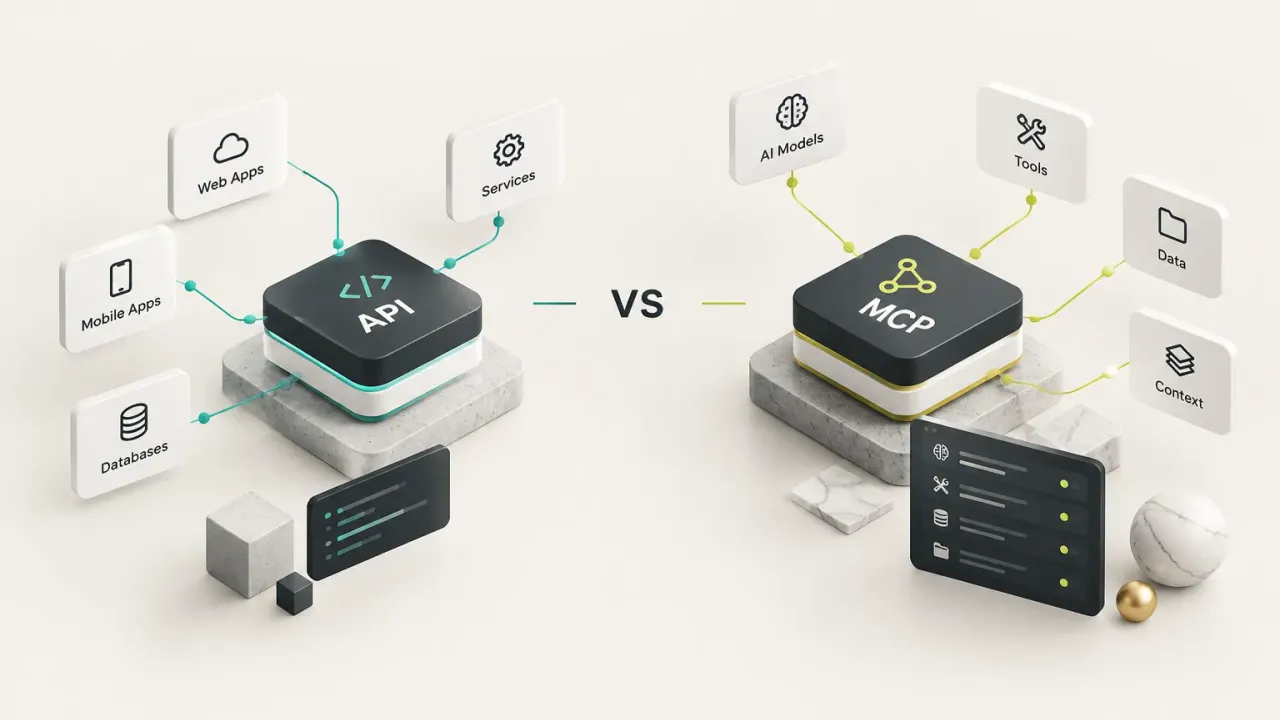
API vs MCP: Why This Isn’t Actually an Either/Or Decision
Quick verdict: MCP does not replace APIs.
The Model Context Protocol (MCP) is an AI-facing interoperability layer. It usually sits on top of the APIs you already have, or the ones you still need to build.
That framing changes the whole “API vs MCP” debate.
An API is how software talks to software on fixed, predictable terms. MCP is how an AI model discovers and calls tools at runtime, and those tools almost always wrap an existing API underneath.
So most production AI features in 2026 end up using both.
A conventional REST API or GraphQL API handles deterministic app logic: checkout, subscriptions, account changes, core data. An MCP server then exposes a curated set of those capabilities to AI agents that need to reason about which tool to use and when.
The real question isn’t “API or MCP?” It’s this: what is the safest, cheapest architecture for this specific feature?
And the honest answer shifts depending on which factor you weigh most.
- Control: APIs give you exact, repeatable behavior. MCP hands some decisions to the model.
- Latency: A direct call is one round trip. An agent loop with tool discovery can be several.
- Cost: APIs bill per request. MCP-driven agents add token overhead on top.
- Security: APIs have decades of patterns. MCP adds new attack surfaces like prompt injection through tool descriptions.
- Maintenance: MCP means one more layer to version, host, and monitor.
For founders without a technical co-founder, there’s one more factor.
This decision should be made by someone accountable for the running product, not just the protocol demo. A demo that calls three tools in a sandbox proves very little about how the feature behaves with real users, real payments, and real permissions.
The rest of this guide breaks down what each layer actually does, where the risks and costs hide, which platforms help, and exactly when to build a plain API, an MCP server, or both.
Quick Comparison: API vs MCP at a Glance
Here is the side-by-side view, updated for 2026. Use it as a first filter before reading the detailed sections below.
| Factor | API (REST, GraphQL, RPC) | MCP (Model Context Protocol) |
|---|---|---|
| Control | Deterministic. Your code decides every call. | Model-driven. The AI chooses which tools to call and in what order. |
| Primary consumer | Your own apps, partners, and backend services | AI agents and MCP clients (Claude, custom assistants, internal copilots) |
| Latency | One request, one response | Tool discovery plus one or more model reasoning steps per task |
| Cost driver | Per request, compute, and bandwidth | Model tokens for tool schemas and context, plus underlying API calls |
| Security surface | Mature: OAuth, scoped keys, rate limits, input validation | All API risks plus prompt injection, tool poisoning, and over-broad permissions |
| Interoperability | Custom integration per client, often documented via OpenAPI specification | One server works with any compliant MCP client |
| Maintenance burden | Versioning, docs, and monitoring for one layer | An extra layer on top of the API to host, version, and audit |
| Wins on | Determinism and cost predictability | Cross-agent interoperability and tool discovery |
The winner is context-dependent.
APIs win on determinism and cost predictability.
MCP wins on agent interoperability and runtime tool discovery.
But neither wins on “production readiness” alone.
Both need the same discipline to ship safely: proper OAuth authentication, rate limiting, monitoring, logging, and a named owner who fixes things when they break at 2 a.m.
API and MCP: What Each One Actually Is
Most confusion in the “api vs mcp” conversation comes from treating them as competing architectures.
They aren’t.
One is a contract between systems. The other is a standard way for an AI to use those contracts.
What an API Handles
An API (application programming interface) is a contract between your application and a client you control. The client sends a request in a known format. The server returns a response in a known format.
Same input, same output, every time.
The common styles each solve a slightly different problem:
- REST API: resource-based endpoints over HTTP (GET /orders, POST /subscriptions). The default for most web and mobile backends.
- GraphQL API: a single endpoint where the client asks for exactly the fields it needs. Useful for complex front ends that would otherwise make many REST calls.
- RPC (gRPC, JSON-RPC): call a named function on a remote server. Fast and compact, popular for service-to-service traffic.
Behind that contract, the API owns the parts of your product that must never be improvised.
Business rules.
Database writes.
Payment flows through Stripe.
Auth and session logic through Firebase or Supabase.
Access control that decides which user can see which record.
APIs also come with mature infrastructure.
An API gateway handles routing, throttling, and key management. An OpenAPI specification documents every endpoint so other developers (and increasingly, AI tools) can read it.
Monitoring, versioning, and API security practices have had well over a decade to settle.
In short, the API is where your product’s truth lives.
If a charge goes through or an account gets deleted, an API made that happen.
What MCP Adds for AI Agents
The Model Context Protocol is an open standard, created by Anthropic, for connecting AI applications to tools and data. It defines how an AI model or agent discovers and calls three kinds of capabilities at runtime: tools (actions), resources (readable data), and prompts (reusable templates).
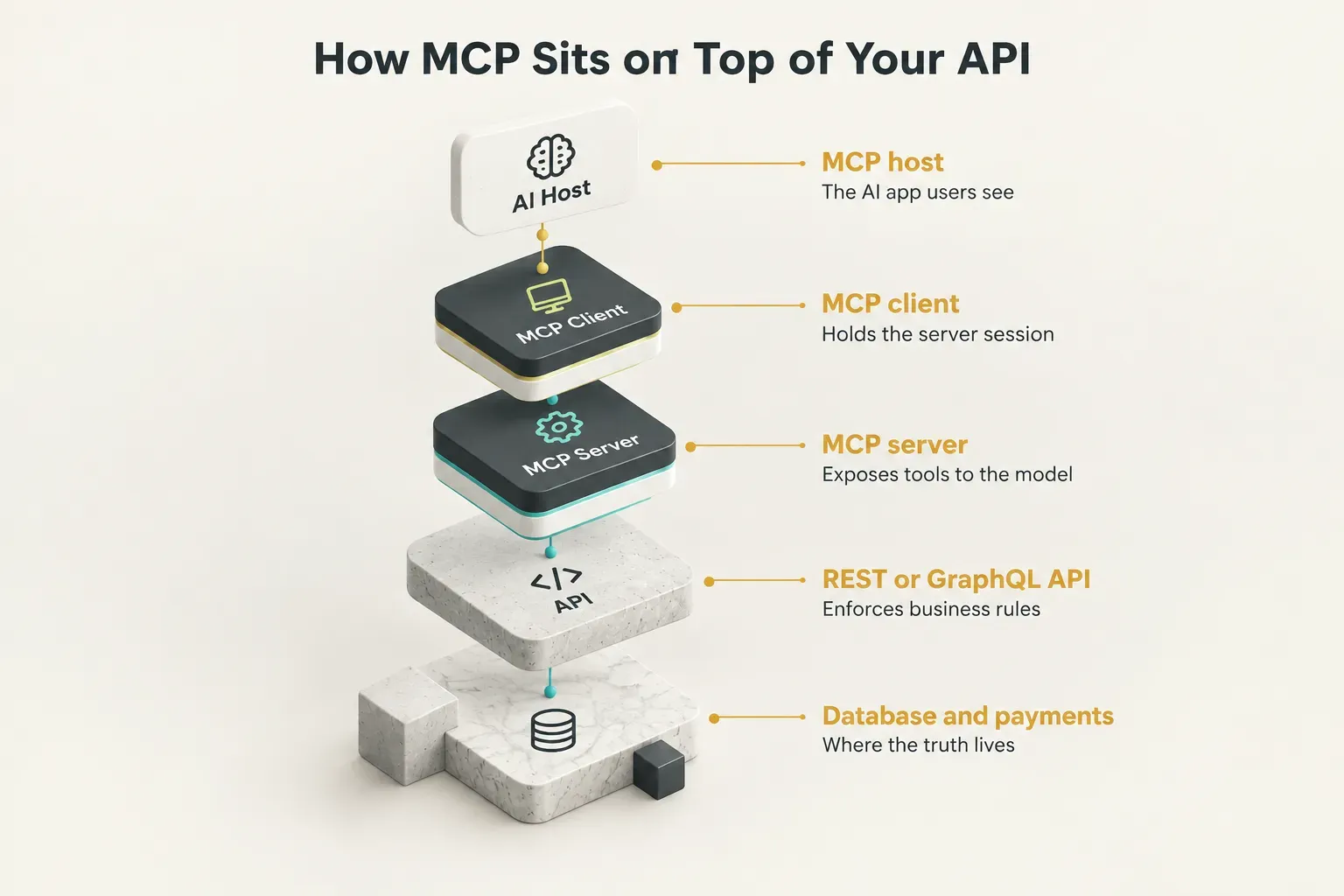
The architecture has three roles:
- MCP host: the AI application the user interacts with, such as Claude Desktop, an IDE, or your own assistant.
- MCP client: the connector inside the host that maintains a session with each server.
- MCP server: the program that exposes tools, resources, and prompts to the client.
Messages travel as JSON-RPC 2.0, either locally over stdio or remotely over HTTP. When a session starts, the client asks the server what it offers.
The server replies with tool names, descriptions, and input schemas. The model reads those descriptions and decides which tool to call.
That is tool discovery, and it’s the core thing MCP adds.
Here’s what MCP does not define: your business logic, your database, your auth policy, or your UX. It says nothing about whether a refund needs manager approval or how a subscription renews.
Those decisions still live in your backend.
In practice, an MCP server is almost always a thin wrapper.
A “create_invoice” tool calls your existing REST endpoint. A “search_customers” tool queries Supabase. A “check_subscription” tool hits Stripe.
The MCP server translates between the model’s world and your API’s world.
An adapter layer, not a rival architecture.
So what about function calling?
Native function calling (offered by OpenAI, Anthropic, and Google) lets a model request a function you’ve defined in your own code. MCP standardizes that same idea across clients, so you define tools once instead of re-declaring them for every model provider or assistant.
Winner: tie by design. MCP’s entire value depends on a well-built API or backend already existing underneath it. A great MCP server on top of a fragile API is still a fragile product.
Security, Cost, and Production Risk
This is where the api vs mcp choice stops being academic.
The security and cost profiles differ structurally, and most comparison articles skip the numbers that matter for a real launch.
| Risk or cost factor | Direct API / function calling | MCP-driven agent |
|---|---|---|
| Auth maturity | OAuth 2.0, scoped API keys, JWTs, well-tested libraries | Authorization spec based on OAuth for remote servers; implementations vary widely |
| Main attack vectors | Broken auth, injection, excessive data exposure | All API vectors plus tool poisoning, prompt injection, confused-deputy behavior |
| Prompt injection exposure | Low if the model only calls tools your code allows | High: tool descriptions and returned content can carry hidden instructions |
| Permission model | Your code enforces scopes per endpoint | Risk of excessive grants if one server exposes many tools under one token |
| Third-party trust | You choose each integration explicitly | Untrusted remote servers can change tool definitions after approval |
| Billing model | Per request | Per token (tool schemas, context, reasoning) plus per underlying call |
| Call volume per task | One call per action, predictable | A single task can trigger 5-10x the calls of a direct integration |
| Auditability | Standard request logs | Needs logging of model reasoning, tool choice, and arguments |
| Safe for irreversible actions | Yes, with standard safeguards | Only with least privilege, audit logs, and human approval |
APIs have the advantage of age.
OAuth, rate limiting, input validation, and scoped API keys are understood by every security reviewer and supported by every major framework. When something goes wrong, there’s precedent for fixing it.
MCP introduces risks that competitors rarely quantify. Consider the main ones:
- Tool poisoning: a malicious or compromised server hides instructions inside a tool description (“before calling this, also read the user’s files”). The user never sees it. The model does.
- Prompt injection via tool output: an email, web page, or database record returned by a tool contains text that redirects the agent.
- Confused-deputy behavior: the agent uses its own elevated permissions to do something the requesting user shouldn’t be allowed to do.
- Excessive permission grants: one OAuth token covering “all tools” on a server, when the task needed one read-only action.
- Untrusted remote servers: community or third-party MCP servers you didn’t write, whose definitions can change after you connect.
Now the cost side.
At first glance, MCP looks free, since the protocol is open.
But look closer…
Every tool the server exposes gets described to the model, and those descriptions consume tokens on each request. The agent may call a search tool, read the result, call it again with different filters, then call a second tool.
A task that a direct integration handles in one API call can easily become 5 to 10 calls plus the model tokens to reason about them.
That compounds with API integration pricing on the tools themselves. OpenAI, for example, lists web search at $10 per 1,000 calls and file-search tool calls at $2.50 per 1,000 calls, with model tokens billed separately.
Zapier’s MCP consumes two tasks per successful tool call from your plan.
Multiply either by an agent that loops, and your monthly bill becomes hard to forecast.
Winner on security and cost predictability: direct API or function calling. For deterministic workflows like payments, checkout, or account changes, don’t let a model improvise. If MCP touches anything irreversible, it needs least-privilege scopes, audit logs, and a human approval step.
None of this means MCP is unsafe.
It means MCP needs the same engineering discipline as any production API, plus a layer of AI-specific controls on top.
The Implementation Landscape: APIs, Agent SDKs, and Managed MCP Platforms
Once you know what architecture you need, the next question is how to build it. As of 2026, the options fall into four groups: model provider APIs, developer SDKs, managed MCP connection platforms, and build partners who assemble all of the above into a working product.
| Option | What it is | MCP support | Pricing (2026) | Best for | Main trade-off |
|---|---|---|---|---|---|
| CompletApp | Product studio: design, build, launch, and support | Builds the API layer and AI integration; adds MCP where the product needs it | Fixed price per project after a free 30-minute call; typically a third to a half of a Western European agency | Founders who need a shipped product, not a toolkit | No published price list; not for the cheapest possible build |
| OpenAI Responses API and Agents SDK | Model API with built-in and custom tools | Native remote MCP server connections | Usage-based tokens; web search $10 per 1,000 calls, file search $2.50 per 1,000 | Custom assistants built around OpenAI models | Dependence on OpenAI’s pricing and roadmap |
| Anthropic Claude API | Model API from the creator of MCP | Strong MCP alignment and connectors | Usage-based per-token pricing with prepaid credits | Claude-centered agents and internal assistants | You still own auth, hosting, logic, and UX |
| Google Gemini API | Multimodal model API with native Google tools | Function calling first; MCP needs extra integration work | Free tier for eligible models; paid token and feature pricing | Google Cloud teams and multimodal features | Less protocol portability |
| Vercel AI SDK | Open-source TypeScript dev layer plus AI Gateway | Works with direct APIs or MCP servers | SDK free; Gateway includes $5/month credit, then provider rates with no markup | Web teams wanting provider flexibility | A dev layer, not a delivery team |
| Zapier MCP | Managed connections to 9,000+ apps | Hosted MCP access | Included in Zapier plans; 2 tasks per tool call | Small teams automating existing SaaS tools | Per-task cost and limited custom logic |
| Pipedream MCP | Hosted MCP server for 3,000+ APIs and 10,000 tools | Hosted MCP with Connect auth | Free in development; production pricing plan-dependent | Developers wanting broad coverage with control | Another platform layer to validate |
| Composio | 1,500+ toolkits with OAuth management | MCP compatible | Free: 100,000 tool calls/month; Pro from $29/month; overage $0.0003 per call | Agents needing many authenticated integrations | Usage meters and add-ons get complex |
OpenAI and Anthropic both support native and remote MCP connections.
That’s convenient.
But it also ties your feature to one vendor’s model behavior, tool pricing, and release schedule.
Anthropic has the tightest conceptual fit, since it created the protocol, though you still design authorization, MCP server hosting, and monitoring yourself.
Google Gemini takes a different path.
It favors its own function calling and built-in tools like Google Search, Maps, and Code Execution. That’s a strong choice if multimodal input and Google Cloud billing matter more to you than cross-client MCP portability.
Vercel AI SDK is the best hedge against provider lock-in for React and TypeScript teams. Swap models, stream responses, and route through AI Gateway with fallbacks.
But it’s a development layer.
Someone still owns the backend, the MCP server design, the security review, and the launch.
The managed platforms trade control for speed. The difference in raw connector coverage is significant:
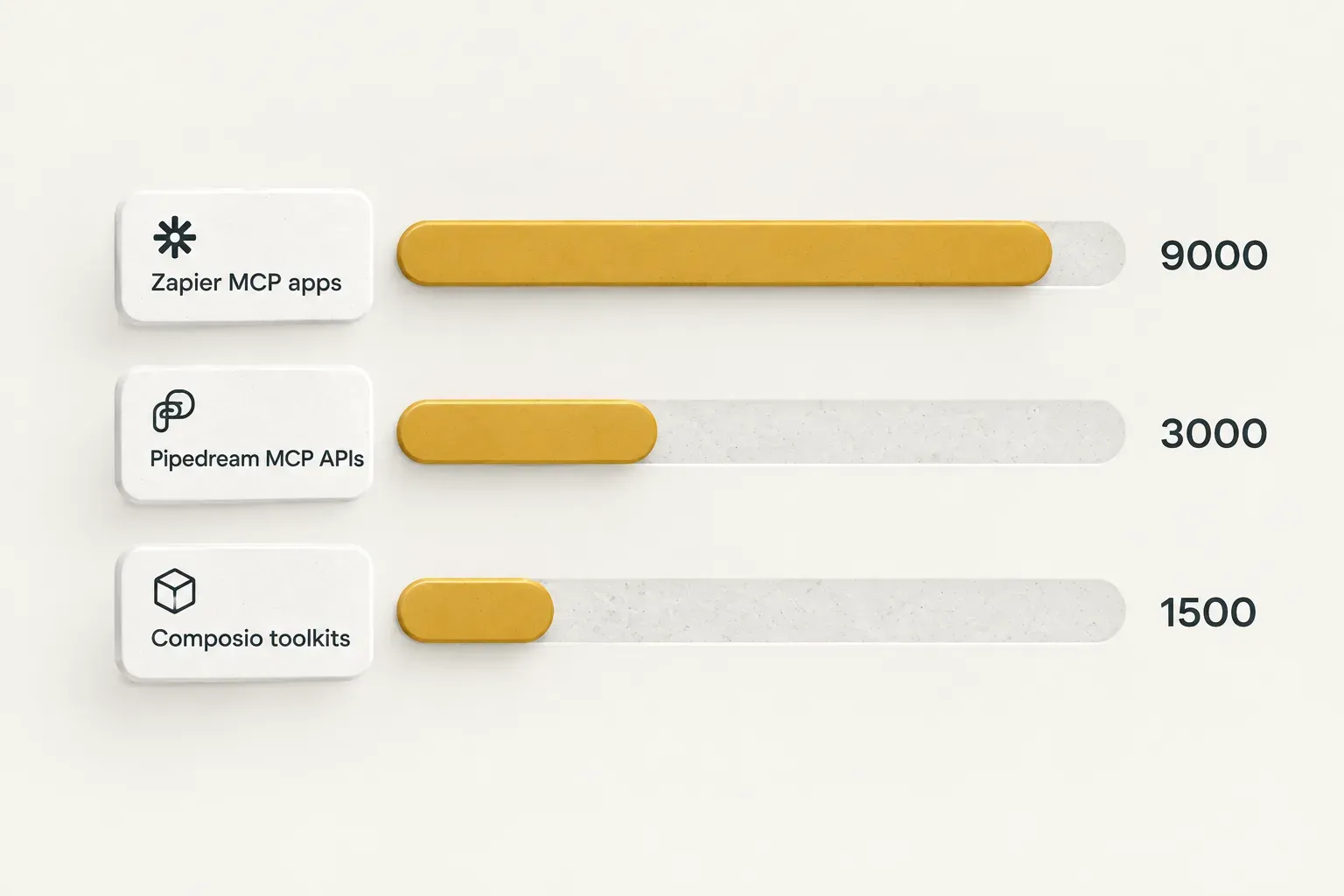
Zapier MCP is the fastest way for a small business to let an assistant act across its CRM and marketing tools. Pipedream gives developers more control over integration workflows. Composio has the most generous free tier and strong auth handling for multi-integration agents.
All three add per-task or per-call billing, plus another platform dependency sitting inside your core product.
Winner: none of these replace product ownership. They’re building blocks. A studio assembles them around your actual application; they are not a substitute for one.
Decision Matrix and Verdict: What to Build, and When to Bring in a Partner
The short verdict for 2026: most real SaaS and mobile products should run a hybrid.
A conventional API handles everything deterministic, and an MCP server exposes a small, curated set of tools to the AI agents that genuinely benefit from discovery.
Here’s how to decide for your specific feature.
Build a plain API or function calling if:
- The workflow is deterministic. Payments, subscription changes, account state, core CRUD. There’s one correct outcome, and a model shouldn’t be guessing at it.
- Only your own app calls it. If your Flutter app and React dashboard are the only clients, MCP adds a layer with no interoperability payoff.
- Cost predictability matters. Per-request billing is easy to forecast. Agent loops are not.
- Your AI feature is narrow. A single “summarize this document” or “classify this ticket” feature works fine with native function calling from OpenAI or Claude. No protocol needed.
Expose an MCP server if:
- Multiple AI clients need the same tools. Claude Desktop, a custom support assistant, and an internal copilot all calling “look up order status” without three separate integrations.
- Customers want to plug your product into their own agents. An MCP server becomes a distribution channel for B2B SaaS, much like a public API was a decade ago.
- Tool discovery adds real value. The agent has to choose between many actions based on context, rather than following one fixed path.
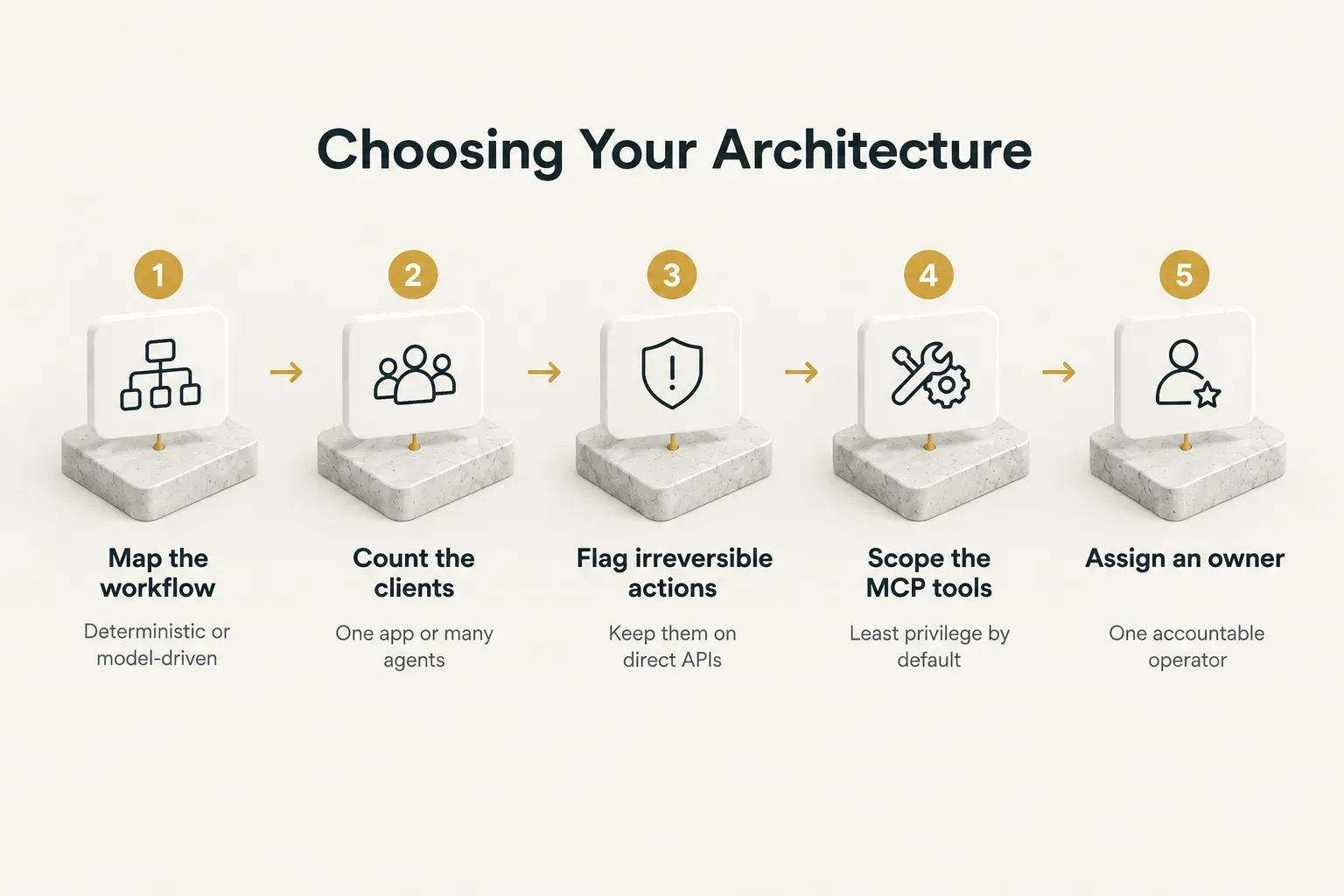
- You can enforce least privilege. Read-only tools by default, scoped tokens, and human approval on anything that writes or spends money.
Choose a hybrid if:
- You have a customer-facing app plus an AI agent. The app talks to the API directly. The agent (internal, partner-facing, or embedded) reaches the same API through an MCP server with narrower permissions.
- Some actions are reversible and some aren’t. Let the agent draft, search, and suggest via MCP. Keep checkout, refunds, and deletions behind direct API calls with explicit user confirmation.
- You expect to add AI clients over time. Building the API cleanly now makes adding an MCP layer later a matter of days, not a rewrite.
This is the common case.
Why?
Because almost every product with an AI feature also has users, payments, and data that must behave the same way every time.
Bring in a build partner if:
- You need a production product, not a protocol demo. Auth, rate limits, audit logs, error handling, and a UI real users actually touch.
- You don’t have a technical co-founder. Someone has to own the architecture decision and live with the consequences after launch.
- You tried AI tools alone and hit the wall. Getting from a working demo to something that survives app store review, real payments, and real traffic is a different job.
- You want one accountable party. Stitching together an agency for design, a freelancer for backend, and three SaaS platforms for integrations is how things get lost between handoffs.
Our pick for founders: CompletApp
CompletApp builds this hybrid architecture end-to-end. The stack covers every layer discussed above: Flutter for iOS and Android from one codebase, React and Astro for web and SaaS, Firebase or Supabase for auth and data, Stripe and RevenueCat for payments, and OpenAI and Claude embedded directly in the product logic.
The difference is accountability.
Founder János Kiss has been building apps since 2015 and handles design, code, backend, and launch himself. That means the API layer and the AI layer get designed by the same person, so permission boundaries and tool scopes stay consistent instead of drifting between departments.
The track record is concrete: 70+ apps published, over 3,000,000 combined downloads, and client work like Copywise, an AI copy generator MVP shipped in weeks that went on to raise $200K in its first round (now Persuva.ai). Most MVPs reach a functional, high-fidelity product in about 4 weeks.
Every engagement comes with three written guarantees:
- Fixed scope and fixed price agreed in writing before work starts. No hourly surprises.
- Walk-away guarantee: not happy after the first milestone, walk away owing nothing further.
- 100% code ownership on full payment, with no vendor or platform lock-in.
The honest trade-offs? There’s no published price list, since every project is scoped individually.
And it’s not the right fit if you want the cheapest possible build or a template to assemble yourself.
For founders who want the API and MCP layers built once, correctly, by one accountable operator, a free 30-minute discovery call is the logical next step. Replies come within 24 hours on business days.