What micro saas really means in 2026
Building software has never been cheaper.
Selling it has never been harder.
That tension defines every micro saas decision you will make this year.
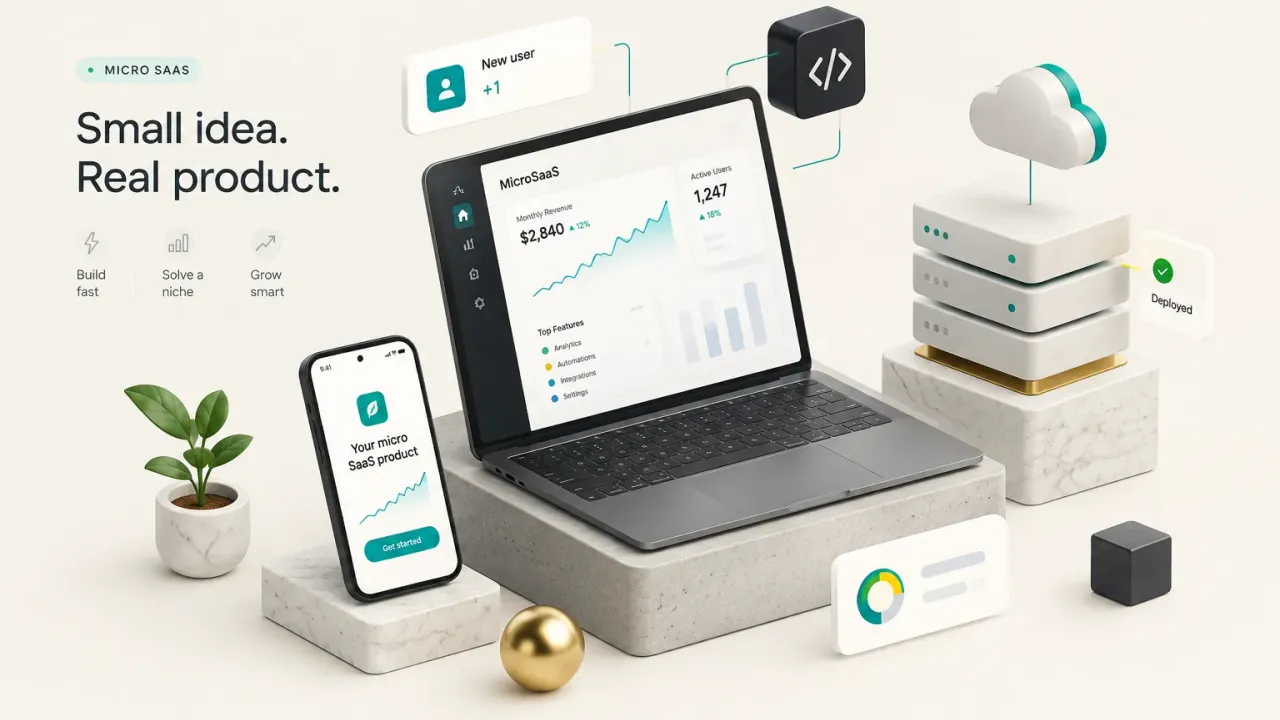
A micro saas is a small, focused software product, run by a solo founder or a team of two or three, that earns recurring revenue by solving one narrow problem for a specific group of customers. Think of a scheduling add-on for physiotherapy clinics, or an invoice reminder tool for freelance translators.
Small scope, clear buyer, monthly payments.
This guide is not a list of 50 ideas. It also isn’t a collection of revenue screenshots from founders who got lucky in 2019.
It is an operating guide covering how to validate demand, decide how to build, set up the infrastructure a real product needs, and judge whether to keep going.
Why does the model still work in 2026? AI coding tools have collapsed the cost of a first version.
Anyone with a weekend and a prompt can ship a demo. And that has flooded most obvious categories with lookalike products.
But the barrier was never really the code.
The products that survive own a specific customer relationship, a workflow, or a distribution channel that a generic tool can’t copy overnight.
Niche knowledge still compounds.
Trust with a small community still compounds.
In 2026, the scarce asset in micro saas isn’t the ability to build. It’s the ability to prove, quickly and cheaply, that a defined group of people will pay.
That is the lens for everything that follows.
What actually makes a product a true micro saas
Plenty of founders call their project a micro saas when it’s really something else. The label matters because each model has different economics, different risks, and different exit options.
Misread it and you’ll make the wrong decisions for months.
The practical micro saas test
Run your project through four questions. If it fails any of them, it’s a different kind of business.
Does anyone pay for it yet? If not, it’s a side project.
That’s fine, but a side project has no revenue signal, so you can’t measure problem-solution fit or retention. Free users tell you almost nothing about willingness to pay.
Are customers paying for software or for your time? If revenue scales with hours you personally work, you’re running a freelance service with a software wrapper.
A true micro saas sells access to a product that keeps working while you sleep.
Was it built for many customers or for one? A tool built to a single client’s spec is an agency deliverable.
Even if that client pays monthly, you carry all the concentration risk of a consulting contract.
Is growth driven by funding or by customers? A venture startup raises capital to chase a large market fast.
A micro saas grows on its own revenue, with no investor timeline forcing a pivot toward “bigger.”
Pass all four, and you’re looking at a genuine micro saas. The defining traits are consistent across successful examples:
Self-serve subscription billing, where customers sign up and pay without a sales call. One narrow problem, solved well.
A lean or solo team. No outside funding pressure.
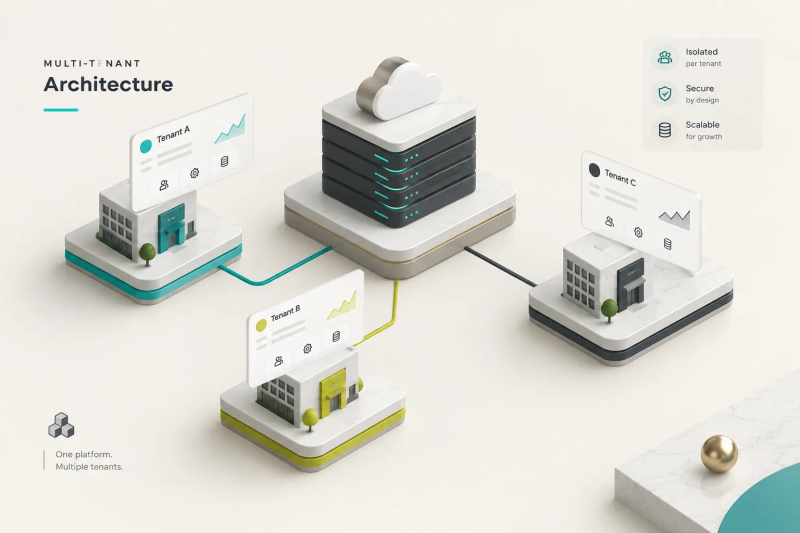
And a low infrastructure footprint, usually a single multi-tenant architecture on managed services, not a fleet of custom servers.
Can one person really run it
Yes, at first.
Most solo operators run a micro saas on roughly 10 to 25 hours a week once the product is live. Early on, that time splits between building, talking to customers, and answering support.
The split changes as you grow. At 20 customers, support might take two hours a week.
At 200, it can easily eat half your available time if onboarding is unclear or the product has rough edges.
Most founders hit the first wall somewhere between 100 and 300 active customers, depending on product complexity. That’s usually where a part-time support contractor, a better help center, or a freelance developer for maintenance becomes necessary.
Not optional.
Necessary.
A useful rule: if a single bug or a week of illness would leave customers stranded, you’ve outgrown the pure solo model. Build documentation and hire help before that week arrives, not during it.
The real economics behind a micro saas
Here’s the uncomfortable math most guides skip. Building the product is usually the cheapest part of the business.
Acquiring and keeping customers costs more, and it never stops.
What it actually costs and takes to build
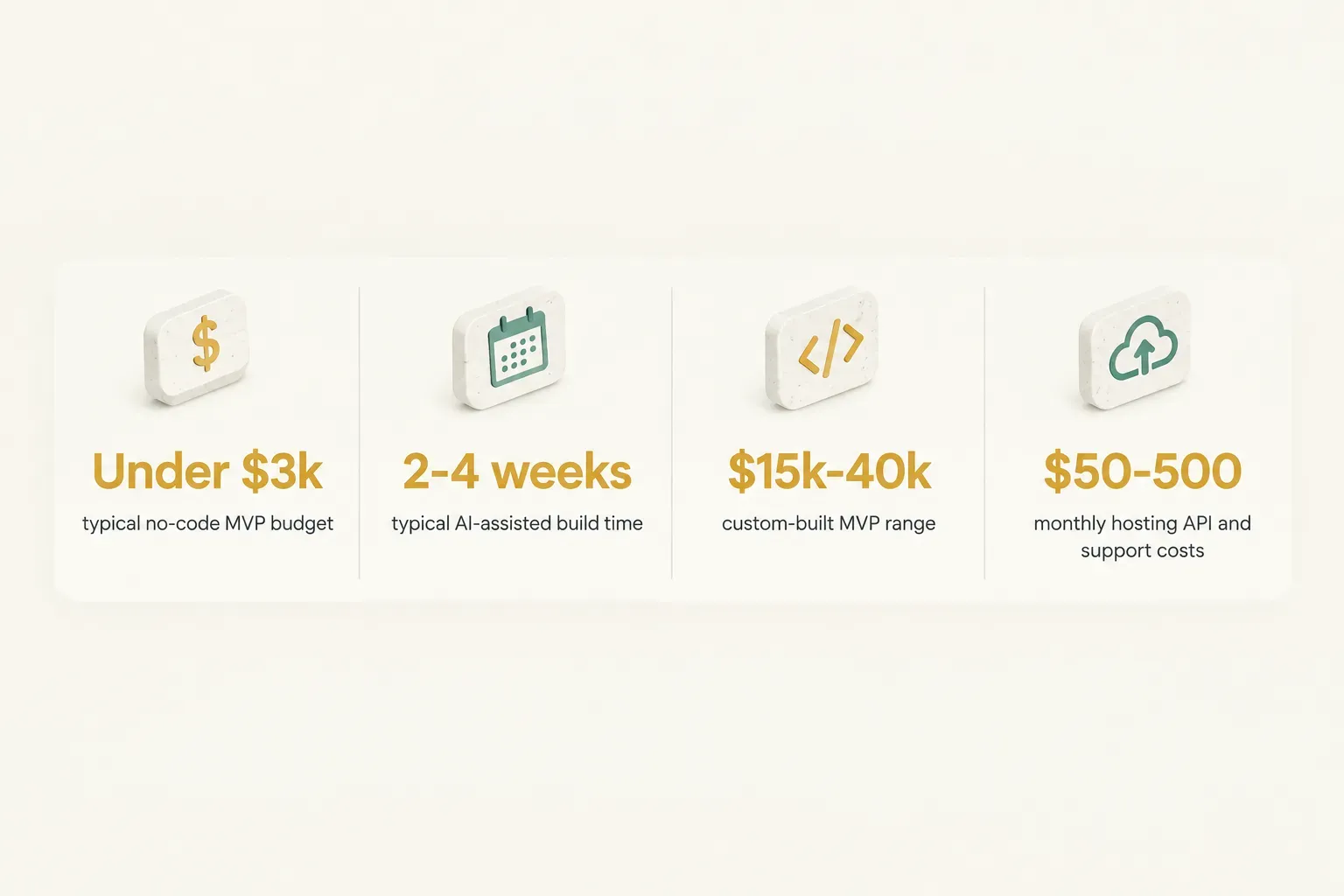
Your build cost depends on the route you take. As of 2026, realistic ranges for a minimum viable product look like this.
No-code development (tools like Bubble, Glide, or Softr) can produce a working MVP in days, typically for under $3,000 including subscriptions and any freelance help.
AI-assisted development, where a founder or developer uses AI coding tools to generate much of the codebase, usually takes 2 to 4 weeks and costs $3,000 to $15,000.
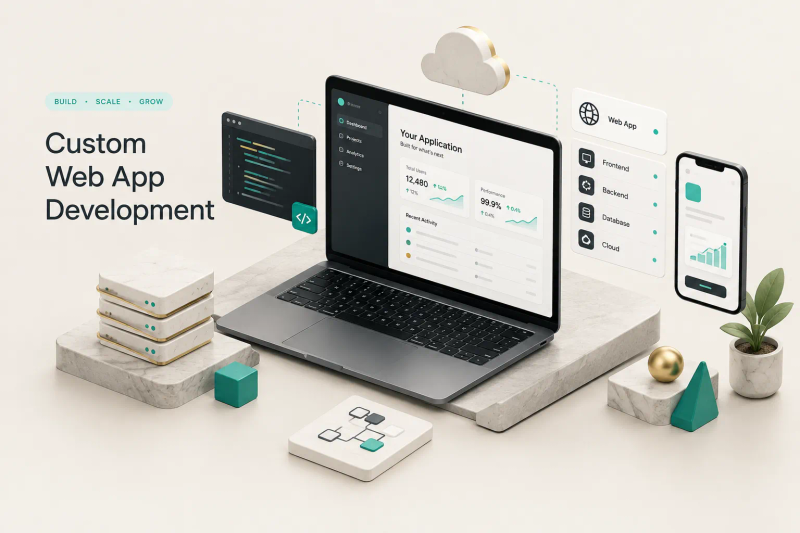
Fully custom web app development runs 4 to 8 weeks and $15,000 to $40,000 for a focused MVP.
Then come the running costs. Hosting, database, email delivery, third-party APIs, and support tooling typically add $50 to $500 per month.
AI-heavy products sit at the top of that range, or above it, because model API calls scale with usage.
Now the costs nobody puts in the spreadsheet.
Customer acquisition cost (CAC) is the first. Even “free” channels like community posts and content cost founder hours, and paid channels for niche B2B tools often run $100 to $400 per customer.
Second is churn replacement. At 5% monthly customer churn, you lose roughly 46% of your customer base in a year.
That means nearly half your marketing effort goes into standing still.
Third is founder support time. If each customer needs 20 minutes of help per month, 100 customers cost you about 33 hours monthly.
Multiply that by what your time is worth, and a $19 per month plan can quietly become unprofitable.
Validating demand with real evidence
Most failed micro saas products were “validated.”
Just with the wrong evidence.
Weak signals feel encouraging but cost the customer nothing. Survey responses, upvotes, waitlist signups, and “I’d definitely use that” comments all fall here.
People are polite.
They are not committed.
Strong signals require the customer to give something up. Access to their calendar, inbox, or internal workflow.
Repeated manual requests for the same output. Pilot usage with their real data, not test data.
And the strongest of all: pre-orders, deposits, or a signed paid pilot.
The fastest way to collect strong signals is a concierge MVP. Instead of building software, you deliver the outcome by hand.
If your tool will generate weekly compliance reports, you produce those reports manually in a spreadsheet for five paying customers.
This feels inefficient.
It is.
That’s the point.
You learn exactly which steps customers value, which ones they ignore, and which ones deserve automation. Good customer discovery through concierge delivery often cuts the eventual feature list in half.
If five people won’t pay you to do the job by hand, software won’t change their minds.
Building an mvp that won’t collapse later
An MVP has two jobs. It must deliver the core value well enough that customers pay, and it must be built on foundations you won’t have to tear out at 50 customers.
Most founders get one of those right. The decisions below help you get both.
Choosing the smallest useful feature set
Version one should feel almost embarrassingly small. Every extra feature adds testing, support questions, and maintenance that a solo team pays for forever.
What belongs in version one:
- The single core value loop. The one action that delivers the outcome customers pay for, from input to result, working reliably every time.
- Account creation and login. Simple email or social sign-in, with password reset that actually works. Customers judge your reliability here before they ever see the product.
- Basic billing. One or two plans, a free trial or paid pilot, and self-serve cancellation. Charging from day one is the only reliable test of demand.
What to explicitly leave out:
- Admin dashboards. Use your database console or a simple internal tool until you have enough customers to justify a proper back office.
- Multiple API integrations. Pick the one integration your ideal customer profile uses most. Every additional integration is another external system that can break without warning.
- Custom roles and permissions. Team accounts with granular access controls are a v2 or v3 feature, built only when paying customers ask for them repeatedly.
- Advanced analytics and reporting. A single summary screen beats a configurable dashboard nobody opens. Add depth once you see which numbers customers check.
No-code, AI, or custom code
These three routes are often treated as interchangeable shortcuts to the same destination.
They aren’t.
Each one makes different trade-offs on the things that matter once real customers depend on you.
- Maintainability. No-code is easy to change early but becomes tangled as logic grows. AI-generated code is fast to produce but often inconsistent in structure, making later changes risky. Custom code written to a clear architecture is the easiest to extend after month six.
- Data ownership. No-code platforms hold your data and logic on their infrastructure, and migrating out can mean a full rebuild. AI-assisted and custom builds on services like Supabase or Firebase give you direct database access and export control.
- Scalability. No-code tools often hit pricing or performance ceilings around workflow volume. AI-generated code can scale, but only if someone checks database queries and architecture. Custom builds are designed for growth from the start.
- Security. No-code inherits the platform’s security model, which is fine until you need custom rules. AI-generated code frequently ships with exposed keys, missing access rules, or unsafe defaults. Custom code is only as secure as its developer, but a competent team will review this explicitly.
- Technical debt. No-code debt shows up as platform lock-in. AI-generated debt shows up as code nobody fully understands. Custom code debt is the most visible and therefore the most manageable.
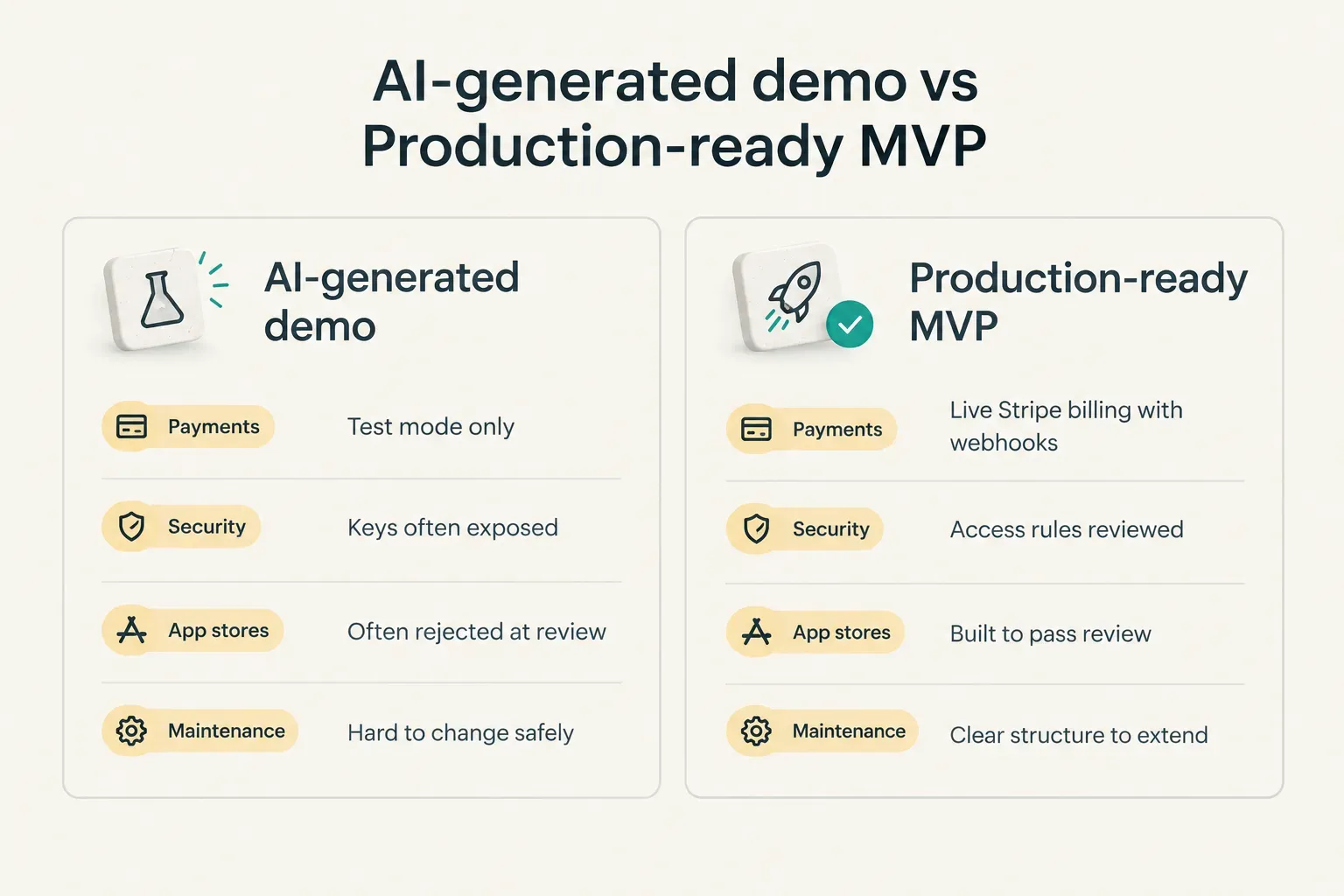
The wall usually appears at a predictable moment. An AI-generated demo looks great in a screen recording, then breaks when real users sign up, when Apple or Google reviewers test the app, or when live Stripe payments and subscription webhooks enter the picture.
That gap between demo and durable product is where a development studio fits.
CompletApp, for example, builds custom MVPs with Flutter, React, Firebase or Supabase, and Stripe, working to a fixed scope with a roughly 4-week MVP timeline. It’s one option for founders who have validated demand and need a product that survives contact with paying customers.
Infrastructure a small product still needs
“Micro” describes the team and the scope.
It doesn’t excuse missing the basics.
Customers paying monthly expect the same reliability they get from much larger tools.
Regardless of how you build, plan for these from the start:
- Authentication. Secure sign-in, password reset, and session handling through a proven provider. Never roll your own.
- Subscription billing. Plans, trials, upgrades, failed-payment retries, and cancellation, typically through Stripe or Paddle. Failed-payment recovery alone can rescue several percent of revenue each month.
- Privacy and data controls. A privacy policy, data export, and account deletion. GDPR and similar laws apply to small products too.
- Error monitoring. A tool like Sentry so you hear about crashes before customers email you about them.
- Backups. Automated daily database backups, plus one tested restore. An untested backup is a hope, not a plan.
- Analytics. Basic event tracking for sign-up, activation, and core actions, so you can run cohort analysis later.
- Onboarding and support channel. A short welcome flow, a help page, and one clear way to reach you. Email or in-app chat is enough.
Launch, pricing and the roadmap ahead
Launching is not a single day. For a micro saas, it’s a 90-day stretch where every week either strengthens or weakens the case for continuing.
Finding reachable customers first
Here’s a test worth running before you build anything: can you name, specifically, where your first 10 to 50 customers will come from?
Not “LinkedIn.”
Not “SEO.”
Actual places with actual people.
Reachable communities tend to fall into four groups. Niche forums and subreddits where your ideal customer profile asks for help.
Slack and Discord groups organized around a profession or tool. An existing audience you already own, like a newsletter or a client list.
And partnerships with tools or consultants who already serve your buyers.
If you can’t list at least three concrete channels with real member counts, the idea isn’t ready.
Distribution is the moat in 2026.
A mediocre product with a clear path to its buyers often beats an excellent product shouting into the void.
Pricing mapped to customer value
Price should follow how customers experience value. Two questions decide most of it: how often does the customer get value, and how predictable is that value?
Subscription pricing fits frequent, predictable value, like a tool used weekly in a workflow.
Usage-based pricing fits value that varies a lot between customers, such as API calls or documents processed.
Freemium works only when free users spread the product and conversion costs nothing to support, which is rarer than founders hope.
Lifetime deals bring fast cash but create permanent support obligations with no ongoing revenue, so treat them as a short validation tactic, never a model.
Transactional pricing suits occasional, high-value outcomes, like a one-off report.
Hybrid pricing, a base subscription plus usage, suits AI products where your costs rise with customer activity.
One practical rule: avoid pricing under $15 per month for B2B tools. Support time and payment fees eat most of it, and low prices attract the highest-churn customers.
Metrics beyond mrr, and when to pivot
Monthly recurring revenue is the headline number.
It’s also a lagging one.
By the time MRR drops, the problem started months earlier.
Watch these instead.
Activation rate: the share of sign-ups who complete the core value loop within their first session or week.
Cohort retention and churn: what percentage of each month’s new customers are still paying after three and six months.
Customer concentration risk: if one customer represents more than 20% of revenue, you have a client, not a market.
And contribution margin after support and infrastructure, which tells you whether growth makes money or burns it.
Benchmarks from SaaS analytics providers like ChartMogul consistently show that low-priced products serving small businesses churn faster than higher-priced ones. Strong retention rate and healthy customer lifetime value relative to CAC (aim for at least 3:1) separate products that compound from those that stall.
Some ideas are simply too complex for the micro saas model.
Red flags include heavy regulation (healthcare records, financial advice), deep integrations with legacy enterprise systems, real-time infrastructure like live video or trading, dependence on a marketplace or platform that can change its rules overnight, and high-touch support where every customer needs training calls.
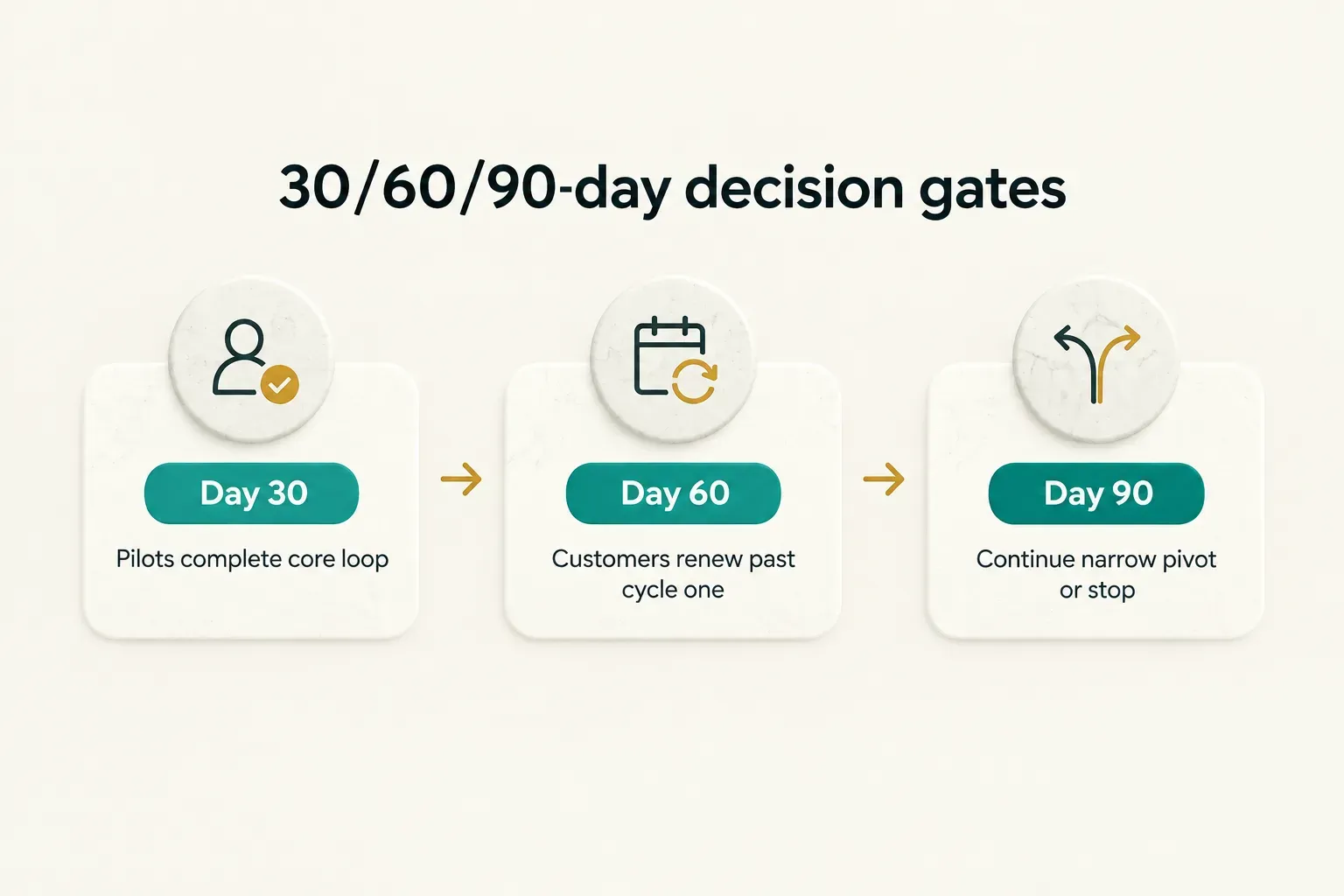
Set decision gates before launch, so emotion doesn’t make the call for you.
By day 30, you want pilot users completing the core loop with real data.
By day 60, you want paying customers who stayed past their first billing cycle.
By day 90, decide: continue, narrow to the segment that’s working, pivot the offer, or shut down.
Shutting down at day 90 isn’t failure.
It’s the cheapest lesson available.
And if it works? Scaling a validated micro saas into a full company means hiring for support and development, investing in annual recurring revenue plans for cash flow, hardening security and compliance, and possibly expanding into adjacent problems.
At that point you’ve found product-market fit, and the playbook changes.
The micro part was the proof.
The one decision that matters tonight
If you take one action from this guide, make it this: validate with a paid pilot or concierge delivery before you write a single line of code.
Five paying customers served by hand will teach you more than six months of building in private.
Once you have that proof, the build decision gets simpler.
Technical founders with spare time can start lean with no-code or AI-assisted tools and rebuild later if needed.
Nontechnical founders, or anyone handling payments, personal data, or app store distribution, should consider a custom build from day one.
The real constraint in micro saas is rarely the code.
It’s proving that someone will pay before you scale anything.
Solve that first… and the rest becomes engineering.